Friday, October 19, 2012

Exhibition at Turnberry

Here's David with part of a small exhibition he put on at the Turnberry Resort, on the occasion of the World Curling Federation's inaugural Annual Congress, see here.

Using items from his own collection, David showed the evolution of the curling stone, a collection of medals, illustrations, and a variety of stones of diverse origin (Crawfordjohn, Carsphairn, Furnace, Creetown, Blantyre Black, Burnock Water, Tinkernhill, Lednoch, to name a few), illustrating that curling stones used on outside ice in the late nineteenth and early twentieth centuries did not all come from Ailsa Craig!

Many of the WCF delegates found time to visit the exhibition and talk with David about the history of the sport.

Photo by Bob Cowan

Thursday, October 04, 2012

John Cairnie of Curling Hall: Part 1

Much of the material in this post was contained in a paper delivered to Largs Historical Society by David B Smith on September 24, 1998.

Dr John Cairnie was a Stirlingshire man, who after study at the University of Glasgow and an apprenticeship in Edinburgh which qualified him in 1791 as a surgeon, and after a voyage to China, joined the Honourable East India Company. That he should have chosen to work in tropical climes is curious in a person whose later life is almost exclusively associated with the ice of his native land, and the ancient, Scottish manly game which was played upon it. Indeed, if he had not lost part of his left arm in an incident with gunpowder, and retired the Service, I wonder if he would have played the important part he did in fostering the national game of Scotland.

Little is so far known about his early life, beyond that he was born at Dunipace near Denny in 1769. He was the second son of Neil Cairnie, principal partner of the firm of Thomas Shiels and Company, which ran the Herbertshire Printfield in Denny. I am sure that there is much to be learnt about his earlier years and of those he spent in the service of the East India Company. We know that he first served for some years in Ceylon and that in 1802 he was promoted surgeon and thereafter served with the 2nd Madras Native Cavalry. We do not yet know the nature of the incident which separated the good doctor from his left hand, and, therefore, from the practice of surgery, but we do know that he retired to Scotland, where he married Agnes Galbraith in 1805.

It is usually stated that Cairnie settled in Largs in about 1810 and proceeded to build his well-known villa (Curling Hall). He may well have moved to Largs before that. John Cairnie joined the Duddingston Curling Society in January 1804, before it had begun to become the very important club that it later was. In the minute recording his admission he is designed already as of Largs.

It is clear fom Cairnie’s writing that his love of Scotland’s ancient, manly game of curling was something that had been inculcated in him from an early age and that it survived the burning heat of India. Indeed, it was perhaps this very heat that burned his obsession into him. He must have been curling-daft to give his house the name of a game that was not before his arrival played in the parish of Largs. Anyway this is his account of an early encounter with the game to which he was to give so much:

"We had a famous match on a sheet of water called the Drumlie Meadow, near the village of Denny. The most of us mustered on the ice before eight o’clock in the morning, and finer ice, perhaps, never was seen that was water-borne.

We had an early breakfast and a collection was made for a supply of vivres to be used on the ice during the play. These consisted of bread and cheese with porter ad libitum; and such of the company as chose had hot pints prepared, consisting of porter, eggs, biscuit, sugar, and whiskey, of a consistency as thick as ordinary porridge - and well might it be called meat and drink - and altho’ we partook freely of all the refreshments, we believe the whole party kept perfectly sober, at least none of them were so tipsy that they could not handle their massy granites with best effect; and that they were massy cannot be doubted, as one pair of them weighed 72 lbs. each stone. They were played by a very powerful man named William Gourlay, who at that time we reckoned the king of the Curlers; and the execution done by them was most surprising, for, when forcibly played full, they moved after taking off the guard, and in their progress often raised half a dozen stones in succession and gained the shot that was declared to be impregnable. Opposed to this chieftain of a player was an ambidexter named Aleck Cook. He was also a powerful man, and had arms of extraordinary length, which he could swing so high with the curling stone behind him, that when about to raise the double guards, a person standing on the tee opposite could see its entire bottom. Several games were played, and it had been so arranged that every curler was to have a lanthorn and candle on the ice, which, with the aid of a fine moon, enabled us to continue the game till four o’clock in the morning, when, after emptying every bottle and pint stoup, we parted, much against the wishes of some of us, who would have preferred making out the 24 hours on the ice."

James Meikle in an article about the King of Curlers tells another story from Cairnie's youth:

"On a certain occasion one of his own name, in spite of friendly warnings, played a rink of stones at Denny over ice that was much too weak, with the result that the whole lot went to the bottom of the pond. The accident would not have mattered had not the stones been required for an important match on the following day. Having reviewed the whole situation carefully, Mr Cairnie, all heedless of the biting blast that was blowing and the deep and dangerous character of the pond, calmly divested himself of his clothing and dived for the stones, one after another, until all were safely landed. It is pleasant to be able to add that Mr Cairnie was so little the worse of his adventure that he assisted in brilliant style to play the rescued 'channel stanes' to victory on the morrow."

These two stories show us something of the man. He was an enthusiast, and he carried his passion to extreme lengths.

The population of the parish of Largs at the time when Cairnie moved there was about 1800 souls. We do know that the village was then more isolated than later for it was not until later that the turnpike road from Largs to Kilbirnie and beyond was built. It was not until 1838 that the gasworks was erected, and until 1839 that the streets were lit by gaslight. Similarly, when Cairnie came there was no harbour of any efficient sort. Steamships began to ply in his lifetime, and a company was started, with thirty-one shareholders, of whom Cairnie was one, and it sought the power by private Act of Parliament to build a harbour at Largs, which was first used on December 1, 1834.

Cairnie and his friends indulged in all the usual gentlemanly pursuits of the day. He certainly enjoyed hare-coursing and no doubt kept a few grews [greyhounds] of his own. Meikle suggests, God forfend, that he participated in cockfighting. He kept a pair of small but high-mettled black horses for drawing his comfortable, yellow coach.

He certainly liked bowls and made a superb green in the grounds of Curling Hall, to which his many friends were invited. Sailing was obviously also a passion. His yacht, the Nancy, lay at her mooring off the shore below his villa during the summer, and on her cradle beside it during the winter. He was a founder of the Royal Northern Yacht Club.

One can confidently assert, however, that all these interests gave way to his obsession, the roaring game. In fact, although the frontispiece to his Essay depicts two of his great joys, the yacht and Curling Hall, he gives the game away by what he writes of it: "The frontispiece shows a view of our Cutter coming to her moorings with a few selected pieces of granite for Curling sport, taken from the shore of Ailsa Craig; and on the hills behind, in the distance, the Largs and Gogoside Clubs have their natural ponds, which supply an extensive field of ice in a frosty winter."

Not only was the vessel pressed into service for the carriage of curling stone metal, it served other curling purposes. Cairnie says, "We cannot help making one more digression, and letting the inland curlers know how we at the seaside occasionally amuse ourselves after our day’s sport. We have what we call pic-nic dinners, where every Curler provides his own dish, and brings the drink he likes best. We, last season, had four of these pic-nics, and the scene of festivity was on board of our cutter, lying high and dry upon her carriage, by the seaside."

From the end of the eighteenth and, particularly from the beginning of the nineteenth century, curling as a sport began to be organised in properly constituted clubs, or societies, to use a term commonly used at that period. Cairnie not only introduced the game of curling to Largs but he was involved in the institution of the first club, The Noddle Curling Club. On the reverse of the title page of the surviving minute book of the Noddle Club appears in Cairnie’s hand. "The first curling was at the pond beside South Kirkland House on the 13th December 1813; the commencement of a long continued and severe frost - The Members formed themselves into a Society in the Spring of 1814 but no book was kept before that now commencing December 10, 1814."

In his own book Cairnie writes, "In the month of January 1814 the Curlers had fine sport on the Noddle Burn, and were so delighted with it, that they adopted the name of the Noddle Club."

The minutes further record play on a loch under the Bankhead House, and upon a loch on the muir near Fichen which is, of course, south of the main Kilbirnie road. As early as January 1815 the Noddle boys were off to a loch in the Island of Cumbray near Mr Ewing’s house. (It is worth saying of the use of the word 'loch' that it appears to have done service for any patch of water, however formed, whether it was permanent and large, or artificial and small, or it just happened to be there because of a wet back end. You must remember also that the scientific draining of fields was in its infancy and that, therefore, there were many more 'lochs' around then than now.)

The members of the Noddle club a few years later decided to form themselves into the Largs, or Largs Thistle, Curling Club - the name under which it still exists, and a rival club to the Noddle, the Gogoside, was formed shortly thereafter.

As already mentioned, the earliest Noddle Minute Book survives. For a period Cairnie was the secretary and kept the minutes, and used the book as a sort of personal curling diary.

The flavour of the man comes through. He refers to himself, as befits a secretary, in the third person but that does not prevent him from making his personal views about people and events very clear. Here are some entries from the winter of 1819-20.

13 December 1819. "... Four most excellent games ... Two bottles were emptied upon this occasion. Mr Cairnies’ party gained all the four games and were in high spirits at their having shewn such good play to players supposed inferior to few..."

15 December. "... Two bottles of whisky part of a bet gained by Mr Carnie were produced and another bottle of common whisky for the use of the club ~ looking like a change of weather."

On 20 December during a thaw he wrote a curling will in the book by which he gave some stones for the use of the club.

29 December. "... a bottle of rum from Mr Craig (a bett) was consumed; a bottle of whisky from Mr Cracknell ... Played till 5 pm"

31 December. "... Victory again crowned the side of the Secretary... A slam was the produce in this game Arthur’s side being 8 Shotts to 0 - alias nothing. It was agreed (the Ice being mostly covered with snow) that it be cleared immediately and orders to that effect were given - A bottle of Radical Whisky was consumed, and the party with the Secretary left the ice at half past 3 leaving a side to practice ... this year has afforded more sport, than the five previous years all put together."

1 January 1820. "The Secretary being unable to form a proper party this night (with the assistance of a fine moon etc.) he sent a challenge to John Bull who did not appear in time, but 3 of the Members Messrs T. Underwood R. Brown and J Cairnie after the clock struck 12 had several curls with the stones on the frost - who should play farthest - J.C. Victor."

1 January, later. "...Bad play all day, partly from the bias on the ice, but more so from seeing in the new year - 2 bottles one of Rum the other of Whisky old betts were consumed on the ice; parliament cakes in abundance.... It is pleasant to think tomorrow is a day of rest for my bones and back and all feel sore and out of order..."

15 January. "...Some showers last night, but icicles appear at 9 am; altho’ now soft enough to course the weather has all the appearance of frost - The Secretary coursed at Skelmorlie; killed 2 hares.”

18 January. "...A challenge from the Comrate people was sent and should the day answer it will be further reported upon tomorrow - ..."

20 January. "...This day the following party went to Cumbraes to play the players in that quarter - It was past 12 O'clock before anything was fixed or ready for play and before beginning it was agreed in presence of many persons betwixt The Secretary and Mr Wishart that the game should be 21 -

Sides:
Mr Cairnie
Mr Lang
Mr Craig
Mr Jamieson
Mr John Lang
J Wilson from Largs
R Wood
A Dayer

An equal number opposed them with stones quite unfit to appear on any rink of Curlers, some were Oval, some triangural and only one of them fit for Muster. On ending of the game the members were 21 to 12 - in favour of the Noddle or Largs - here as Mr Wishart forgot the number fixed on The Secretary left the ice resolved not to play that person again upon any terms ~ The Secretary’s pocket bottle, and an odd bottle gained by him from Mr Ewing together with the bett for a pint; Cheese and Bread were consumed ~ N.B. Should I ever play those Curlers again, I shall take care their stones shall be agreeable to those in our; in all other Clubs, had that been the case it is in my opinion doubtful if the Comrate party would have reckoned one in the game."

On 21 January they played and beat Kilbirnie, and Cairnie treated them all to "2 bottles and 14 pyes @ 4d."

On 24 January he summed up the season by stating that at least 49 games had been played. "We can also boast of beating the Kilburnie picked side and of a trifling victory over a sett of beginners upon the Comrate."

That triumphant summation of the season is important from two points of view. First, it shows that Cairnie, though every inch a sporting man, was not quite what we would call a good sportsman: he did not like to lose. Second, it illustrates how precarious was the game of curling, for it depended entirely on the chance not merely of frost but of continued frost. That is why The Secretary exulted in the large number of games they had played.

You may be wondering about the nature of the lochs and ponds upon which Cairnie and his friends had such good fun. These were shallow water ponds. They were generally constructed for the sport, and were generally large enough to accommodate several games simultaneously.

(I said 'generally' advisedly, for many a stretch of water, designed for a different purpose, was commandeered by the curlers.)

The mode of construction was usually this. Earthen banks were put around the levelled area and a sluice constructed to allow water to be put on in November and let out in March. The depth of water was six inches to a foot. Curling clubs throughout the country spent a prodigious deal of time, energy and money on planning, making, and maintaining such ponds. The advantage of a shallow pond over a natural loch was that it took less frost to freeze it, but it still required a frost of three or more days’ duration to create ice of sufficient strength to bear a game of curlers and their stones, and autumn’s floods could wash away the summer’s building work, and water voles could by their burrowing make the bankings like a sieve.

These perennial and different problems were solved by Cairnie. About 1827 he put to the test the idea he had been carrying around in his head for about twenty years, that of creating a perfectly level, impermeable surface, onto which, as soon as the thermometer reached 32 degrees F, water could be hosed or sprinkled to form ice almost instantaneously. It will not surprise you to hear that, "We were led to think of this simple invention from a plan we, with many other boys, have practised in our younger days, that of making ice on pavement, which we have often done to the great annoyance of his Majesty’s lieges."

Cairnie’s idea caught on at once, and all sorts of different surfaces were utilised, wood, tarmac, cement, even cast iron plates with flanges which were bolted together and supported on brick piers. The number of potential days of curling was quadrupled.

In 1833 Cairnie was forced to write a book about his invention, for it had come to his ears that the Rev John Sommerville from Currie in the Edinburgh area was claiming the invention as his own. The Essay on Curling and Artificial Pond Making was the result. Polemical in intent and somewhat intemperate in language, it does nonetheless include a delightful mixter-maxter of curling lore, and we are all in debt to the minister from Currie for that. An anonymous reviewer of the book in Johnstone’s Edinburgh Magazine says after recounting some of Cairnie’s amusing anecdotes, "All this pleasant information was given to Mr Cairnie of Largs, an amateur Curler, whose discovery of artificial rinks promises to do for the noble game what rail-roads have done to travelling, and steam to voyagers."

Cairnie did not leave it to others to blow his horn: throughout the rest of his life he extolled the virtues of his ponds and exhorted clubs to make them. In a letter which I own he writes to the curlers of Kilmarnock in 1840, "With my Curling rink at Kilmarnock I am certain you would have every year nearly 3 months Curling." In a letter written shortly after, he wrote, "I cannot refrain from giving your Club some account of my success in making sport for the Curlers. On my artificial rink I have this day had in succession 15 days of the finest ice possible for Curling. I certainly think I should get at least a vote of thanks for my improving the sport, and have thoughts of having a second Edition of my book published.”

Part 2 is here.

Top: John Cairnie. This engraving appears as a frontispiece to the Grand Caledonian Curling Club Annual for 1844. This is described therein as follows, "Prefixed to the Annual is a lithographed likeness of Mr Cairnie of Curling Hall, first President of the Royal Club, taken from a miniature of him which was lindly sent to us by Mr. Lindsay, Secretary to the Belfast Curling Club. That Club, we believe, is the only existing offshoot on the other side of the Irish Sea; at any event we know that it is the only club in Ireland which is associated wiith the Royal Caledonian, and we have been informed by the gentleman referred to, that it owes both its existence and affiliation to the influence of Mr. Cairnie. The resemblance of the lithograph is very good, and brings at once to our remembrance of the old gentleman when he came into the Waterloo Rooms..."

Middle: Frontispiece from Essay on Curling and Artificial Pond Making

John Cairnie of Curling Hall: Part 2

David B Smith continues the story of John Cairnie, the first President of the Royal Caledonian Curling Club. Part 1 is here. The oil painting above, in the Royal Club's collection, shows curling at Curling Hall c1833. The artist's surname is McLennen, of whom nothing is known. Image from Bob Cowan's archive.

In an addendum to his Essay Cairnie had written with approval of a proposal by the anonymous writer of a book on curling that had appeared in Dumfries in 1830 that there should be a national curling club for Scotland. Five years after he wrote this, it came to pass.

Many people think that it was Cairnie who inserted the advertisements in the North British Advertiser in May 1838, which resulted in the meeting at the Waterloo Hotel, Edinburgh, on July 25 at which the momentous decision was taken to found just such a club, the Grand Caledonian Curling Club. There is no doubt he was there, and indeed he was elected to the chair of the meeting. No doubt he had a pile of his Essays under his good arm. But I am inclined to believe Cairnie himself when he wrote in a letter of July 1840 to the vice-president of the Kilmarnock Curling Club, "You are mistaken if you think I had any hand in the getting up of the Grand C. Club ~ it was from some anonymous notice that I attended in Edinburgh. I believe the author was a Kinross man, and I think the formation will look better yet ~ The rules etc. Require much improvement."

False modesty was not one of Cairnie’s virtues. He craved recognition for the invention of his artificial rinks. I personally think it most unlikely that if he had had a direct part in the founding of the Grand Club he could have refrained from boasting about it. Everyone present at the inaugural meeting must have realised that they were embarking upon a momentous new chapter in the history of their favourite, national sport, for in this regard curling, if not first in the field, was years ahead of other Scottish sports in creating a nation-wide organisation. I cannot see Cairnie denying himself the glory if the idea was his. The Edinburgh Evening Courant in reporting the success of the meeting said that Cairnie, "eulogized this ancient and national game as one which, independently of its own intrinsic merits as a noble and manly recreation, was well calculated to form a bond of kind and elevated feeling, identified as it is with much that is good in our national sympathies and habits."

The editor of the Royal Caledonian Curling Club Annual for 1843-4 - the new club was given royal patronage not long after Cairnie’s death - reminisced about Cairnie at the inaugural meeting, "None who were present on that occasion can ever forget his honest, blunt, kind, and off-hand manner, stranger although he was to us all - a manner which he did not assume for a purpose, but which belonged to his character, and was displayed equally at home and abroad - on and off the ice..."

This image of Cairnie hangs in Largs Museum.

Cairnie died on October 27, 1842, in his seventy fourth year. His obituarist wrote that "he was a man who has gone to his last account with the love and esteem of that sweet marine retreat, where, after a life of activity and usefulness, he had pitched his tent. By every Curler his memory will be held in veneration, for, full of manly enthusiasm himself, he did more to elevate and excite the popular feeling in favour of the 'roaring play' than any man of his times; and 'Cairnie’s rinks' are as familiar as household words to every knight of the broom and channel-stane..."

I have long been curious about the financial circumstances of John Cairnie. In 1998 I satisfied myself to some extent for I consulted in the Register House the inventory of his estate.

His testament was drawn in 1839. It appears that he was comfortably off. The sum total of his moveable estate, given up by his only executor and fellow curler, James Lang of Ferralside, and sworn before the JP and fellow curler, Robert Morris, amounted to £8,611.4.6.

He owned house property and feu duties in Glasgow, a few sums lent on heritable securities, and had shares in Glasgow Gas, and Paisley Gas Company, Paisley Water Company (on whose dams I am sure there was curling), Largs Harbour Company, and Millport Harbour, Paisley Commercial Banking Company, and Renfrew Railway Company. He also had an interest valued at £750 in the ship, Simiramis.

He made provision for his wife, who predeceased him, and for his nephew, Neil Cairnie, junior, (who was at the time of the making of the testament Commander of the barque Trinidad, of Greenock), "until the succession to my real Estate shall open to him and he be put in possession thereof under the joint settlement executed by me and my said spouse" on April 20, 1839.

As well as a specific bequest to Neil Cairnie of "my Gold watch chain and [silver] seals, my cats eye and starsaphyr brooches, my curling stones and bowls" there was a bequest of the residue of his moveable estate to him on his attaining the age of thirty, with a destination over to a list of people, whom all failing "to the Grand Caledonian Curling Club of which Club I am now the President."

There are two codicils which only change his choice of executors, but one written in a train says, "Let not my unnatural brother attend my funeral - let my coffin be laid over that of my dearly departed”. The circumstances in which he came to write the codicil in a rail carriage are described in my article, John Cairnie and the Cowlairs Rail Crash, in the Scottish Curler of December 2005.

In summary, on the morning of July 5, 1842, Cairnie and three other passengers had been trapped in their carriage of the Glasgow-Edinburgh train, when it was hit by the 09.00 Edinburgh-Glasgow train at Cowlairs. Trapped in his carriage, Cainie had penned a codicil to his will.

One of the passengers, John McLeod, a Glasgow bookseller, was to die from his injuries. The pointsman on duty, James Cooper, pled guilty to negligently performing his duties, and was sentenced to twelve months imprisonment.

The mystery of an 'unnatural brother' remains unsolved.

There is nothing to suggest that the injuries sustained in the rail crash caused Cairnie's own death some months later on October 27, 1942.

The following lines appeared at his death.

Why droops the banner half-mast high,
And curlers heave the bitter sigh?
Why throughout Largs the tearful eye,
So blear’d and red?
Oh! Listen to the poor man’s cry!
John Cairnie’s dead!

While winter’s breath as waters freeze,
Lays waste the fields and bares the trees,
Or well-rigged yachts in joyous breeze
For prizes ply,
Cairnie, thy name by land or seas
Shall never die.

John Cairnie is buried in the old churchyard in the centre of Largs, the gravestone surrounded by an iron fence. The inscription on the gravestone is no longer easily read, but is recorded in the museum (which is run by the volunteers of the Largs Historical Society) as 'To the memory of John Cairnie Esquire of Curling Hall, surgeon HEIC service, who died the 27th October 1842 aged 73 years, and Agnes Galbraith his wife who died April 1842 aged 53 years." Photo by Bob Cowan.

Wednesday, September 26, 2012

American Curlers at Ayr Ice Rink in 1952

by Bob Cowan

On Friday, January 11, 1952, a Pan Am airliner called 'Flying Cloud' (* see below) landed at Prestwick airport with twenty-four members of the first team of US curlers to visit Scotland. They were met by Provost Milligan of Prestwick, Walter Bain (the Tour Convenor), John Watson (Ayr), John Allison (Ayr), Thomas Hobkirk (First English Province), and James Hamilton (Secretary of the Royal Caledonian Curling Club). The tourists travelled directly 'by special motor coach' to the Central Hotel, Glasgow, and that evening they were formally welcomed by the Royal Club President, David M Hutchison, and attended a dinner and reception at the City Chambers hosted by The Lord Provost of Glasgow, Sir Victor D Warren. This information comes from a report in the Annual of the Royal Caledonian Curling Club for 1952-53.

The American curlers played first at the Scottish Ice Rink, Crossmyloof, Glasgow, and in the weeks that followed visited the rinks at Ayr, Perth, Aberdeen, Dundee, Falkirk, Kirkcaldy and Dunfermline, before finishing up in Edinburgh for games on February 9. The final days of the tour and the closing celebrations were tempered by the death of King George VI on February 6, and the period of national mourning that followed.

A trophy had been donated for Scotland-USA competition by Commander Herries-Maxwell who was President of the Royal Caledonian Curling Club in 1950-51, see here. In 1952 Scotland emerged on top by 479 shots to 366. The Herries-Maxwell trophy is still played for. Indeed, earlier this year, the American team won it. See this post.

In David B Smith's archive is a reel of 16mm film, taken by local enthusiast David Stratton. The film contains a clip of the American curlers playing at the Ayr rink. David and I arranged for the film to be digitised, and the four minute clip can now be watched here, or just click on the image above. There's no sound.

The original Ayr Ice Rink at 21 Beresford Terrace was built in 1939 for skating, ice hockey and curling. It was demolished in 1972 to make way for a supermarket development. There's a photo of curling at the rink in the web page of the Ayr Figure Skating Club here.

I curled at Ayr a number of times in the 1960s, so seeing this footage brings back lots of memories. One thing I do remember about the timed curling sessions was that the bell would ring, and you would finish the end you were on, and then play one more. In my home rink at Crossmyloof, you just finished the end you were playing when the bell rung. Just how the Herries Maxwell games were played in 1952 is uncertain.

When watching the footage online, look out for the large stage at the end of the rink, the skaters using the end ice, and the wide straw brooms some of the Americans were using.

The Royal Club report does not list all twenty-four players, although some names are evident from the match results at the various rinks, which give skips' names. The USA side included FL van Epps, AB Backstrom, WJ Polski, EW Fiske, AJ Dalton, P Moreland, R Bennett, HW Kochs, C Sargent and EW Freytag. I am sure that this last is the same Elmer Freytag after whom the World Curling Freytag Award is named. Freytag was to become a key player of the US Curling Association which had yet to be formed, and he was one of the founding members of the International Curling Federation which is now the World Curling Federation. Perhaps someone can recognise him in the video.

There is another photo of the US curlers in this post.

*This is most likely to have been the Pan American World Airlines Boeing 377 Stratocruiser, N1028V, Clipper Flying Cloud, which entered service in 1949 and can be seen in this photo, and in the air here. (The earlier Boeing 307 Stratoliner which carried the same name is preserved in the Smithsonian National Air and Space Museum, see here and here.)

ADDED LATER: David Garber has been in touch with the complete 25-strong US team roster, with name and curling club, by USCA state/region:

Grand National
E.W. Fiske, Jr., Ardsley
Albert Shaw, Jr., Ardsley
Mills Ten Eyck, Schenectady
John MacFarlane, Mahopee (Yonkers, NY)
W.R. Henderson, Utica
John P. Carr, Winchester (MA)
Howard Eteson, Winchester
Richard P. Hallowell, The Country Club (Brookline, MA)
Harold S. Cutler, TCC

Great Lakes
Dr. James Lammy, Detroit
John McKinlay, Detroit
A.J. Dalton, Detroit
Paul Moreland, Detroit

Illinois
Elmer Freytag, Chicago
Joseph Jardine, Chicago
Herbert Kochs, Chicago
Chester Sargent, Chicago

Minnesota
Walter Polski, Eveleth
A.G. Backstrom, St. Paul

Wisconsin
David Bogue, Portage
Ross Bennett, Portage
Frank Van Epps, Portage
A.L. Papenfuss, Wausau
Helmus Wells, Wauwatosa
Edward Fitzgerald, Milwaukee

The images are screenshots from the videoclip.

Monday, September 10, 2012

Revisiting the 1976 Uniroyal

by Bob Cowan

It is more than four years since David and I set up the Curling History Blog. One of the earliest posts, see here, was about the 1976 Uniroyal World Junior Men's Championship at Aviemore. The August 27, 2008, post had been stimulated by Bob Kelly lending me a VHS videotape that had been converted from the 16mm film which Uniroyal made for promotional purposes. I said at the time, "This thirty minute film record of the 1976 event is now on DVD. Perhaps one day (soon) it will be possible for all to see again on the web."

Well, as those who have followed this blog will know, I eventually learned how to post clips on YouTube, for example here is the link to clips of the 1962 Scotch Cup, and here is David Smith on Flog It in 2005.

Recently I was contacted by Viktoria Grahn, whose father Anders played in the Jan Ullsten team which was the runner-up to the Paul Gowsell Canadian rink in 1976. She was looking for a copy of the video for her dad! Viktoria's encouragement was what I needed to get the 1976 Uniroyal footage online. It's in two parts.

Part One is here: http://www.youtube.com/watch?v=5oPazqhKcug

Part Two is here: http://www.youtube.com/watch?v=xEO-Hu4jp-g

The quality is not as good as it might be, reflecting the fact that the clips were not digitised directly from the 16mm film, but via a VHS tape. Perhaps in the future it may be possible to make a better copy directly from the original. Uniroyal made a promotional film of the event every year. Copies of these films must surely exist, and it would be great if these records of the early days of the World Junior Championship could be made available. It was junior men only back then of course. It was not until 1983 that European junior women had an international competition to play in, and not until 1988 that the first World Junior Women's Championship was held.

I love Bob Picken's commentary. He was the voice of curling in the 70s and 80s. Great to see and hear teams using the corn brooms. Anders Grahn wields a Rink Rat synthetic broom.

Gowsell and his team of Neil Houston, Glen Jackson and Kelly Stearne were exciting to watch! And of course, the footage is a visual record of the Aviemore ice rink which no longer exists.

Fascinating to see the shots of the crowd and of friends I recognise, some, sadly, no longer with us. Sobering to recognise myself! Here I am standing with David Horton and his father (always 'Mr Horton') who did so much to much to encourage us young curlers back in the day). David's younger brother Ken was third on the Scottish team with Bob Kelly (skip), Willie Jamieson and Keith Douglas. All the records of the competition are in the World Curling Federation's historical database here.

That's me, complete with beard, on the right! Happy days.

The top photo is a screenshot of the victorious Canadians with the Uniroyal trophy.

Thanks again to Bob Kelly for supplying the original VHS tape.

Saturday, September 01, 2012

Swedish Curling 'Medals'

David B Smith writes:

From at least the beginning of the nineteenth century the medal has been used in Scotland both as a trophy to be won at the curling and as a prize of victory.

When one hears the word 'medal' one instinctively thinks of something like the basic definition of the word to be found in the Oxford English Dictionary, 'a coin-shaped metal object, made especially for commemorative purposes. In these senses, the device may have an attached loop or hole for suspension'. And, indeed, most Scottish curling medals conform with this definition.

I was quite surprised, therefore, when I discovered a different tradition in Sweden.

Although the game was first played in Sweden in 1847 it was not until 1916 that a national association, the Swedish Curling Association (Svenska Curling Forbundet) was founded. In 1917 it began a national championship, and from then it produced plaques, or plaquettes, to serve the same purpose as the medal in Scotland.

These plaquettes are basically rectangular in design although there are some slight divergences from rectangularity in some cases.

The first plaquette which I came across bears the oldest date. It is a silver-gilt rectangle, bearing on its obverse a most remarkable design, a depiction of a naked, bearded curler delivering a curling stone (above). His modesty is preserved by a bearskin casually thrown over him. The letters SCF show that this was an official production of the Association. There is, moreover, the signature of the Swedish sculptor who designed the piece, Carl Vilhelm Fagerberg.

Engraved on the obverse are: “A.H.HAMILTON, S.S.C.” and on the reverse “FROM SWEDISH CURLING TEAM DEC., 1923”. This was obviously a gift from the Swedish curlers who toured Scotland for the first time in 1923 to the Secretary of the Royal Caledonian Curling Club.

I have another example of this form of the plaquette, this time a prize. It is engraved: 'ST MORITZ CUP/ 1934 1PRIS'. I have seen silver examples and the latest addition to my collection is one in bronze which reads: 'HOTEL ANGLAIS' HEDERSPRIS 1932 3. PRIS'. A 'hederspris' was a presentation prize.

Fagerberg, 1878-1848, was a well-known sculptor many of whose larger works are to be found in Swedish cities.

The next design I came upon again involved both the SCA and nakedness, this time in the form of a diaphanously clad female figure with bare feet, standing on the ice with a curling stone in front of her, below a conifer branch. That she has a shield bearing the emblem of Sweden, the three crowns, shows that this was Mother Svea, or Mother Sweden. The legend 'Svenska Curling Forbundet' is part of the struck design. My attempt to find the name of the artist who designed this was unsuccessful, but Lars Lagerqvist of the Myntkabinettet (The Swedish Coin and Medal Cabinet) informed me that this was the first design to be adopted by the SCF in 1917, just the year after its foundation.

(The dates of the three examples I possess are 1944, 1945 and 1962. It is not clear to me whether these were won in national or club competitions for no club name is engraved. Perhaps a Swedish reader might help in this matter.)

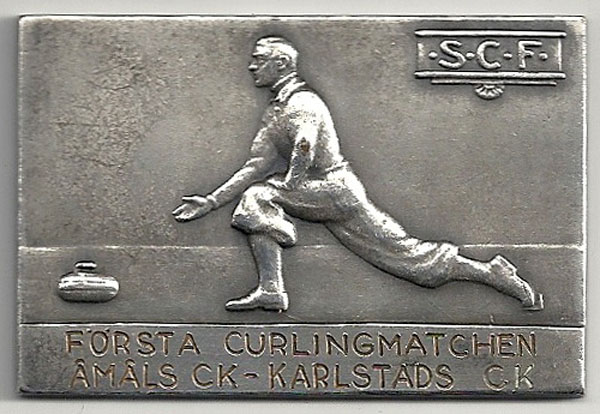
There is another plaquette issued by the SCA and bearing a figure of a plus-foured curler just after he has released his stone. Both of the examples in my collection appear to have been used by clubs. The older example is engraved 'Forsta Curlingmatchen Amals CK Karlstads CK', and it obviously records the first encounter between the named clubs; the second is dated 1969.

The remaining designs are all club plaquettes. One in silver, dated 1938, was the second prize in the club championship of Norrkopings Curling Klubb.

A second played the same role in the club championship of Linkopings Curlingklubb in 1952.

Two are of the same design and were produced in bronze, with the club insignia in black and white enamel, for the Kronprinsens Curlingklubb (The Crown Prince's Curling Club). Of these, one was a presentation to J. Eric Cowper, a Manchester Caledonian curler who was part of an RCCC team which toured Sweden in 1932; the other was a 3rd prize for a competition played in 1948.

The last plaquette is the largest and is bronze but surrounded in mystery. It has no date, but the legend struck as part of the design, 'GLASGOW POKALEN' (The Glasgow Cup), indicates that it has some Scottish connection. In the design a large cup – presumably THE Glasgow Cup - predominates over a curler throwing a stone and a standing sweeper. My internet searches have failed to find a reference to Glasgow Pokalen.

Images © David B Smith

Sunday, August 26, 2012

An 1871 Curling Essay: The Ravenscraig Curling Pond

What a pleasure it is to read in a newspaper of a by-gone age a piece which was intended to be read as literature. The following essay appeared in The Glasgow Herald of Tuesday, January 17, 1871. There is still a railway station near Ravenscraig above Gourock (at Branchton) but the suburbs of Greenock have crept up the hill, and it is no longer a solitary place. The inspiring view across the Firth of Clyde is still there, however, and one can see the Holy Loch and Glen Lean and Glen Massan and the Kilmun Hills. The article is called 'The Ravenscraig Curling Pond' although this is not accurate, and the pond appears to be the rectangular curling pond shown in the Ordnance Survey maps of the area, and to be No. 2320 in the Historical Curling Places list, see here. I am grateful to Bob Cowan for help in identifying the pond. The Gourock Curling Club's website indicates that this pond was opened in January 1867.

The author of the article is not named, other than as a 'Correspondent on the Ice'.

“The Ravenscraig Station, upon the Wemyss Bay Railway, is a solitary place. It lies among heathery wastes, where the whaup finds a refuge. Not a long way from the station the Ravenscraig Curling Pond is sheltered among leafless trees, and screened from the snowdrift that comes over the braes. The pond is a pleasant place in the summer time; the brood of the wild duck find shelter about it. In the winter time the curler knows it is the earliest frozen pond on the sea coast. The naked larch and the black fir form its background; while a brick cottage, lit in the low sunshine, casts rainbow shadows into the ice. In the mist of the winter day the mist the crisp snow has made the whole land beautiful. The brown uplands beyond the Copper Mines are flaked with snow that tempers their blackness. Beyond the heights of Gourock stretch the Argyllshire ranges – the flanks of Glen Lean and Glen Massan, dusky mountains across which the snow has been driving. Against the clear sky the snow shows but faintly – it magnifies by its delicate devices the Kilmun hills. The ravines of Ardentinny Glen melt in a wilderness of snowdrift, across which the sun scatters a tender light. The mouth of the Holy Loch reflects the cloudless sky. It is hardly possible to witness a brighter landscape than this glimpse, with its broken foreground, that light from the placid sea, and that shadowy mountain-land. Ravenscraig Curling Pond is environed by wintry aspects the artist prefers to the hues of the summer. The frosts of the past days had pardoned the ice; the entrance fee of a sovereign had given me a claim to the pond. The pond was the gift of the Lord of the Manor, and so far has been completed. A screen of laurel would add to its look. The club is famous for good players and for the victories they have won. When I reached the pond these had all gone to a great “bonspiel” somewhere. Those left behind were doubtful. The snow had covered the ice; with a snow-rake a rink was cleared, but constant sweeping did not keep the ice bright from the fall. The air was wonderfully silent – the snow folded out the bleakness of the fields.

Curling stones were brought from the club house, skips were chosen, and sides were picked. The skips knew the game: they stood beside the tee, swept away the snow, and gave the green hands very sage advices. One skip or captain of the rink was a very stout man, who used few words, and was evidently accustomed to being obeyed; the other skip was more voluble and eager in his way. The advices referred to “guards”, “hoggers”, “wicks”, and other terms incomprehensible to those who had never thrown a stone before. I was hopeless of knowing what was to be done. A dictionary would have given little insight. The play commenced. When my turn came the skip on my rink shouted in a voice of thunder, “Send it up all your might”. I lifted the curling-stone to a level with my haunch, threw it forward with all the force I could spare, and struck the ice that left a star more brilliant than the Star of India. The curling-stone went whirling along the ice, drove every one out of its way, crossed the opposite tee full speed, and shot up the snow-covered bank. A shout of dismay followed my shot. I had nearly broken the ice. Another such shot and I would ruin the rink. The skip came over to me with a face full of concern. If I had attempted a burglary he could not have looked more severe. “Never lift your stone more than six inches above the ice,” he said, “and push it rather than throw it.” I discovered that the advice contained one secret of curling. My next caution was a mysterious hint not to send my stone “through the house”. The club house stood opposite the end of the rink, and I believed the suggestion was a joke about driving my stone through it. I smiled at the jest, and hurled up the second stone swifter than the first. It swept across the tee, and up the bank like the ricochet of a cannon shot. The skip sprang out of its way and asked what I had for breakfast. I frankly explained, and discovered he was jesting at the strength I wasted. My turn came again. I had not gained much knowledge by listening to the jargon. Our burly skip cried, “A guard! A guard! We have four stones in the house”, and indicated with his broom that I should play gently towards it. I threw the stone with less vigour. A stout burgh commissioner, the skip, an excited Irishman, and three or four besides, frantically jumped in front of the stone, swept the snow away, and shouted, “Sweep him, sweep him, sweep him up, he’s a bonny, bonny guard.” Suddenly the other side cried “A hogger! A hogger!” and the stone was ignominiously pushed aside.

The next player’s stone landed in some dangerous spot, and I was asked “to lift it firm”. I hurled the curling-stone swiftly, struck some other stone, rebounded from several stones, and knocked all our own winners out of the ring. “You’ve cleared out the premises,” the skip cried; “I couldn’t have done it quicker myself.” This mischief seemed worse than going through the house, but I patiently waited for light and encouragement. Once more the skip cried, “A canny, canny draw on here,” holding his broom in front of the stones.I looked at the brush and then at the stone, and threw it. “Bonny laid”, someone cried as the stone glided along, struck a stone wide of the mark, drove two of the opposite stones away from the mark, and landed on the centre of the tee. “A pot-lidder !” “A pot-lidder !” cried several voices; and the skip added, “Wha said you wasna a curler?” I could not see what had happened, and believed I had created new devastation. I crossed the tee, and was pleased to find my curling-stone on the central mark. “A guard! A guard!” cried many. A curling-stone came sweeping along, struck another stone, rebounded against my stone, and sent my “pot-lidder” right up against the bank. My sudden confidence again disappeared.

My turn came round but slowly. “Another pot-lidder”, cried the skip, and this time my stone went out by “the back door”. The second stone I held more cautiously. “A wick off here, and ye’ll touch here, and ye’ll seek him out”, cried the skip. If he had given his commands in Greek or Gaelic they would have been equally intelligible. I sent the stone forward, and was relieved to hear that “I had found him out”, in a wholly unexpected way. The “unknown tongues” were being interpreted when a new trouble appeared. From Gourock several yachtsmen came, and added their “lingo” to the curling tongue. One curly-headed man told me “to take the Commodore upon his lee quarter."

Where the Commodore’s lee quarter lay I could not see. I threw and missed it, but got what a skipper called “a wipe up in the wind”, took a “two sticker” right in the broadside, and carried her “to leeward of the buoy”. I was in despair at following the naval instructions given. I was asked to take “a wick off Paul’s stern, and I would break as many eggs as our steward would want for that day.” “If I only cleared the port my shifting ballast would take me through the schooner’s lee.” I was “to headreach somebody by half a length.” Finally I was told that “if I took the Captain heavy on the starboard side he would never reach the only port open.” The Captain took it easy, and looked on while my own stone went through the port and “lifted” our own “pot-lidder” half way up the bank. I felt satisfied it would take no ordinary patience to pick up curling under such difficulties, and would recommend tyroes, whatever may be the inducements held out, to keep clear of Ravenscraig Pond, unless they have had a preliminary course of naval instruction. While the play was still warm, the sailors found “the dog watch” had come round, and we left as the sunset was fading into purple and the zenith deepened to the night. The crescent of the moon struck a shaft of silver into the burnished ice. The hush of the hills was falling about us as we trudged down the Larkfield Road towards Gourock.”

Sadly, my researches have failed to uncover any picture of curling of this period in this area. However, this lively woodcut of the game in full swing in the Queen's Park in Edinburgh gives some idea of the sort of scene the anonymous “correspondent on the Ice” had before his eyes. It first appeared in The Graphic, of December 25, 1869.

David B Smith