Tuesday, May 05, 2020

Collecting programmes

I once asked if anyone collected curling event programmes. No-one admitted to so doing. Such programmes are not my own focus, when it comes to collecting curling memorabilia. But in these Covid-19 lockdown months, I've finally got around to sorting out a box of old programmes that I've accumulated over the years. Printed programmes may be on their way out, in favour of web based material. But here are some thoughts on a few paper programmes in my 'collection'. Just domestic events, in this case.

 
Here's an early programme, the second junior men's invitation at Greenacres. The event was sponsored by the Scottish Milk Marketing Board, 'Scottish Pride' being one of their brands. And of course 'coit' is an older word sometimes used to mean a curling stone. This was a simple programme, including the draw (a double knockout, with consolation event), but without the names of the competitors.

Can you identify the curling silhouette on the front? It is of course Mike Hay, whose team had won the Scottish Junior Championship the previous season. Although his side had competed at Greenacres in 1982, they did not finish on top, that honour going to Martin Turner (skip), Andrew Hemming, Douglas Wood and Andrew Beveridge.

It is no surprise that I've kept this programme. Among the eight teams in the competition was that skipped by Graeme Adam with Ken Horton, Andrew McQuistin, and me, curling out of the Magnum rink in Irvine. We won the title and went on to play in the Silver Broom in Regina. This was the era when curling and Scotch went hand in hand.

By 1991, the sponsor had changed, and the Scottish Championship was now the Bell's Islander Scottish Curling Championship. Bell's Islander (promoted as 'The Curler's Dram') was, in 1991, 'recently created'. The competition, involving ten teams, was held in the newly opened Dewar's Rinks, in Perth. I'm not sure who designed the programme cover, but the illustration, depicting the game outside, reflects a sport quite different from that taking place inside the Perth venue. But this was no doubt intentional, the notes on the inside cover saying 'It is particularly apt that Scotland's oldest sport should be linked with Scotland's oldest drink'!

Over the years, there's been a variety of designs for the Scottish Championship programmes. For some years, a couple of pages were devoted to lists of past champions.

But in 2015, the full list of past champions was cut off at 1985, with the statement, "A comprehensive list of all Scottish Men's Champions from 1962 is available at www.royalcaledoniancurlingclub.org." A similar statement was attached to the cropped list of Scottish Women's Champions. Missing from the printed lists were the men's champions from 1962 to 1984, and the women's champions from 1977 to 1984.

Those who had been champions prior to 1985 had been despatched into oblivion! Someone had decided that we were no longer important enough to be included in the 2015 programme. No, we were not dead, yet! We were very much alive, and previously had enjoyed finding our names, and those of our peers, on the lists of past winners. Now we had been cast aside, considered irrelevant just because of space constraints in a programme. The distress it caused should be a lesson to programme designers. Include ALL, or none, of past winners.

(I blame the fact that this still makes me angry on the effects of the current lockdown!)

Much more consistent in design over the years, keeping the same font and style, have been the programmes for the Glynhill Ladies International. I have all of these except 2011. Anyone? What was I doing that year that I didn't get to Braehead? And now that the Braehead curling rink has closed for good, perhaps these programmes have a new significance.

The Henderson Bishop Trophy programmes vary a lot from year to year, as the venue changes, as does the local organising committee.

I've picked out this one Henderson Bishop programme. The competition finals were held at the Inverness rink, in February 2012. It's a bit nostalgic for me to remember this competition, as it was the last major event that I photographed, before 'retirement'.
 
I remain puzzled by the cartoon character on the front cover of the Inverness Henderson Bishop programme. Someone will know the significance of this. Does he/she have a name?

 
I will wind up this foray into old programmes with this unusual one, which has Jackie Lockhart and Rhona Martin, World and Olympic Champion skips in 2002, with white moustaches! The Scottish Schools Championship 2004 was sponsored by the Milk Development Council. There was a national campaign which had a number of celebrities with white moustaches.

Atomic Kitten featured on the back page of the programme - just a little different from the product adverts that usually appear thereon.

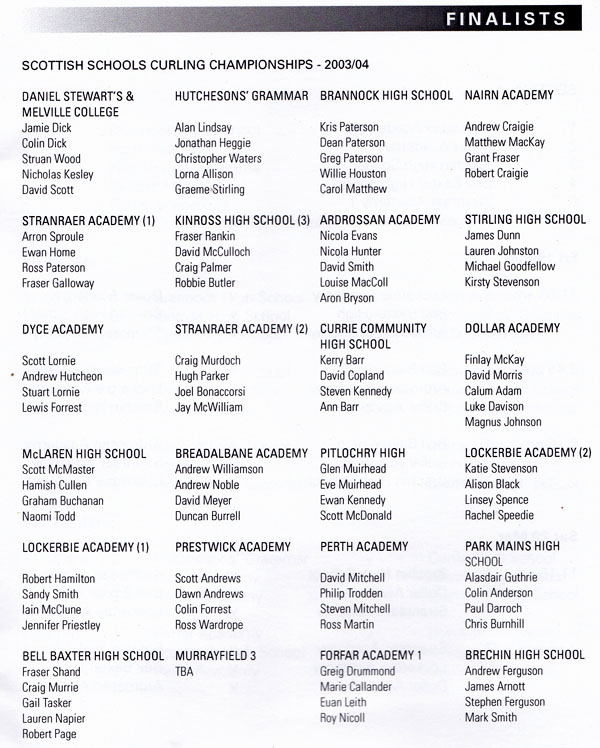
Here are the names of the competitors at Stirling in 2004. One always has to treat such a list with caution, as, on the day of the event, lineups may have changed, for any number of reasons since the programme was printed. But it would be an interesting exercise, to ask a question about retention in the sport, and find out just how many of the young curlers participating in the National Schools Championship in 2004 are still involved curling today. Most will be in their thirties now.

Who won the Schools back in 2004? That was Kerry Barr with her Currie Community High School team of David Copland, Steven Kennedy and Annie Barr. Kerry was the first female skip to win the National Schools title. 

International programmes? That's another story, for another day.

Wednesday, April 08, 2020

The woman who broke her arm and carried on curling in 1879

Cargen House, near Dumfries, was built in 1870 for Patrick Dudgeon, an eminent mineralogist. His Wikipedia entry is here. He had an interesting life, spending some sixteen years as a merchant in China, before returning to Scotland in 1850, and buying the Cargen estate in 1853. He was elected Fellow of the Royal Society of Edinburgh in 1860. He was a trustee and director of the Crichton Royal Hospital for thirty years, and the Deputy Lieutenant of Kirkcudbright from 1867.

He was also a curler, and was President of the Troqueer Curling Club.

In the winter of 1878-79, he had passed his sixty-first birthday and was living at Cargen with his wife Cecilia Jane and their family.

We can conclude that Patrick Dudgeon was a keen curler. Aside from his activities with the Troqueer club, he had a small pond on his estate, and recently evidence has come to light showing that this had been curled upon. This evidence, in the form of a report in the Annandale Observer and Advertiser, was uncovered by Lindsay Scotland when trawling that paper in the British Newspaper Archive for new places to add to those on the Historical Curling Places database.

The article describes a ladies' curling match, with the sides skipped by men, Dudgeon himself and a Mr Gillison, a neighbour. Unfortunately, the women players are not named. What is interesting is the statement that 'In certain parts of Scotland curling amongst the ladies is not uncommon'! The fact that light weight stones had been made, and were being used by the women at this time came as a surprise to me.

I wondered if there was more to be found about these women who played on the Cargen pond. And there was. First of all, in the Dumfries and Galloway Standard of February 5, 1879, there is a list of donations to the recently opened soup kitchen. Two hundred rolls had been donated by Mr Gillison (mentioned above) as 'being result of Ladies curling match at Cargen'. Wagering on curling games was very common in the past. There are extensive reports of matches for 'coals for the poor', or for bags of grain. I believe it was the loser of the game that had to pay for the charitable donation. We can conclude that the result of the ladies match at Cargen was of significance, and that Mr Gillison's side were the losers!

The Dumfries and Galloway Standard of February 5, 1879, also had an article about a ladies' match. The report differs in a number of ways from that above. It may have been an embellished report of the same game, or perhaps of a match played on a different day. The Dumfries and Galloway Standard article has the women skipping the two sides which saw the domestic servants at Cargen (the 'insiders') compete against women from elsewhere on the estate (the 'outsiders'). The skip of the 'outsiders', who unfortunately remains unnamed, fell when delivering her stone towards the end of the game.

She broke her arm, but with the injured limb in a sling, she continued to play and her team ran out the winners! The full report is below.

Women's curling began to take hold in Scotland in the mid to late 1890s, see here, with the formation of several all-woman clubs. But according to the first of these Dumfriesshire newpaper reports, women's curling was 'not uncommon' at least fifteen years earlier, although the second says that is was 'not usual' to find women curling. The search continues to find more evidence of women on the ice in Victorian times, although I have not forgotten that the earliest mention of curling in the digitised newspapers of the British Newspaper Archive (believe it or not) is from 1740, and is of a ladies' match on the Water of Scaur, see here.

Here is the full report that appeared in the Dumfries and Galloway Standard of February 5, 1879.

"A Resolute Lady Curler.
The worthy proprietor of Cargen is known to be an enthusiastic curler, and his enthusiasm, which has infected so many, has not suffered the inmates of his own household to escape, for Mr Dudgeon, jr, is only less ardent on the ice, and, the female domestics of Cargen, inspired by the example of their masters, lately challenged an equal number of the fair sex to a bonspiel. The challenge was accepted, and a meeting took place; the contending rinks being skipped by ladies prompted and directed by gentlemen. It is not usual to find a rink of lady curlers at play. The phenomenon however is not unprecedented. Ladies on skates - at least in Scotland - were never seen, and probably never heard of, till only a few years ago; and it would rather have astonished our snuff-taking and toddy-drinking great grandmothers to have seen how fast it was possible for a young lady to be (on skates) without losing her modesty. But though our grandmothers never tried the skates, they have been known on rare occasions and in obscure localities to turn out with their husbauds and sweethearts to have a pitch in the roaring game. It is long since we heard of anything of the sort having occurred is this neighbourhood however; and in these days when lissom maidens love to skim the ice on skates, our matrons might do worse than exercise themselves by quietly indulging in the more solid and stationary sport of curling.
The result of the match between the Cargen domestics, whom we shall call the insiders, and the ladies residing on the estate - the wives and daughters of farmers and others - whom we shall call the outsiders, was such as to warrant the highest expectations to be formed of female curling: ladies not infrequently become champion croquet players; they might attain similar distinction on the ice as curlers.
On the occasion of which we are speaking the game was in the fullest sense well contested; the ladies threw their stones and laid their cowes like men, doing the work of sweeping as ladies only can do it. Towards the end of the game, however, an unfortunate accident occurred. The lady who skipped the outside rink, in delivering her stone, slipped, fell, and - broke an arm. An accident like this would have sent some fair ones into swoons and many of the sterner sex to bed; not so our heroine, however. It only served to bring out more fully her resolution and enthusiasm. Her rink was likely to win; it would not fail by any failure of hers. So she got her arm in a sling and, going at it single-handed, had the satisfaction of coming off victorious. The lady we understand afterwards procured surgical assistance; but the limb was so swollen that it could not be set and spliced for a day or two."

The 1881 Census detail, from Scotland's People, shows that the Cargen household had eight female domestic servants. Two had been in service ten years before. Frances Austin had continued in her role as a nurse. And Jane (or June) Russell had progressed from being a housemaid to the position of lady's maid in 1881. Elsewhere on the estate, there are many possibilites of women who could have curled. It is frustrating not to know their names, especially the skip who broke her arm.

In the winter of 1878-79, Cargen was not the only place to host a women's game. The Baljarg estate near Closeburn, also in Dumfries and Galloway, hosted a married vs single ladies match, two rinks aside, with all four teams skipped by men. The same Baljarg pond had seen a women's game back in 1861, as reported in the Southern Reporter of February 7 of that year. It does seem that the women of Dumfriesshire were keen to take to the ice back in the day. So much more to discover!

My thanks go to Lindsay Scotland for pointing out the 1879 clipping in the Annandale Observer. The image of Cargen House is from an old postcard. The house was demolished in the 1980s. The British Newspaper Archive is a wonderful resource for anyone interested in curling history.

Monday, March 30, 2020

The First Indoor Grand Match

The early years of the twentieth century saw the Royal Caledonian Curling Club's Grand Match take place at Carsebreck on February 9, 1900, February 11, 1902, and January 16, 1903. Following these great bonspiels, Scotland's curlers waited in vain for the next one. The winters of 1903-04, 1904-05, and 1905-06 all passed without a Grand Match being held.

Behind the scenes though, the Carsebreck venue was improved. The Caledonian Railway Company constructed a platform some 260 yards long, with suitable exits to the field below on the route to the pond. By 1906, a new bridge had been constructed over the River Allan, convenient for the platform exits, and the old bridge repaired. Three small bridges over the ditch adjoining the pond had been renewed. The course of the burn flowing into the pond had been diverted, and the east bank heightened. The other banks of the pond had been repaired and strengthened.

A Secretary's office had been built, accommodating the Club's property, formerly kept in a shed of the Railway Company. All the above made significant inroads into the Club's funds, but showed a continuing commitment to the holding of Scotland's great outdoor bonspiel.

Elsewhere, Scotland's first indoor ice rink was under construction, as this advert from the Royal Caledonian Curling Club Annual for 1906-07 shows.

It was yet to open when the Representatives of Scotland's curling clubs met in the summer of 1907. The entry for the next Grand Match, should there be a cold spell, included 411 rinks from the North, and 352 rinks from the South, the dividing line being the Forth and Clyde Canal.

A C Riddall of Glasgow Northern CC moved that, "In the event of the Grand Match not taking place by 1st March of any year, the Committee of Management and Secretary be authorised to have it played in the Scottish Ice Rink, Glasgow, if arrangements can be made for doing so."

Riddall noted that, if arrangements could be made to play the match at the ice rink, 'it would give a great zest to the old game'. He proposed that there be four sessions of three hours each day, which would accommodate 24 games.

Riddall's motion was seconded by Mr Thomson, Holyrood.

The Rev Dr Fergusson (Airthrey Castle) proposed an amendment, saying that said he thought Mr Riddall was a year too soon with this motion, "This rink, which they were all delighted to hear was nearing completion, and which they all approved of certainly, was not ready yet, and they knew not the manner of the management, how the rink would be conducted, and the charges that would be made, or those details which were necessary for a business company like this to go into."

That brought a spirited defence of the Crossmyloof rink by John Jackson of Glasgow Lilybank, who was the Scottish Ice Rink company secretary. He stated, "It is not a new thing; it is built upon exactly the same principle as Princes Rink (in London), and all of you who have played there know that the ice is admirable. The refrigerating machinery is made by one of the very first makers in the world, and there is no doubt whatever that the ice will be available from the 1st of October, and as my friend will see, we do not propose to ask the Grand Match to come there until after the month of March, very possibly April or May. The rink will be thoroughly well tested before then."

There was further discussion before Riddall's motion was passed by a large majority. The stage was set then for a Grand Match to be held indoors.

 
The 'Scottish Ice Rink' as it was called, opened as planned on October 1, 1907. The curling and skating venue was an immediate success.

This is the only image that I am aware of which shows the exterior of the first 'Scottish Ice Rink'. More on the history of the rink can be found here.

The winter of 1907-08 was not severe, and there was no opportunity for an outside Grand Match. So it was that the first indoor Grand Match was held at Crossmyloof during April 1908!

The Scottish Ice Rink had just six lanes for curling. Despite initial thoughts to hold four sessions per day, the indoor Grand Match went ahead with just three sessions each day. Eighteen games could be played daily. The competition ran from Monday, April 6, and was concluded on the evening of Tuesday, April 28.

The outcome was a substantial win for the South, by 400 shots, 3728 to 3328. A new draw had been made for the indoor Grand Match. I'm not sure how many matches were planned. It could have been 250, certainly less that would have taken place at Carsebreck, for which, as noted above, there had been an entry of 411 rinks from the North, and 352 rinks from the South.

The Annual for 1908-09 lists the results of just 219 games. In addition, thirty matches were held in a President's v President-elect's competition.

The Grand Match trophy was won by the Blantyre CC. They had entered three teams, two of which had good wins over their opposition by 26 and 24 shots, whereas the third team had lost by three shots. That gave the club the highest average shots-up. The gold badges to the rink of the winning club which had the greatest majority of shots went to that skipped by M. Campbell. The trophy to the club having the greatest net majority of shots (other than the club which has won the main trophy) went to the Biggar CC.

The individual game results were published in a large table in the RCCC Annual for 1908-09. That's the first 20 results above. As far as I can see, none of the few women's clubs that were members of the Royal Club at the time competed at Crossmyloof. It is possible that individual women played in a club team, but I have not found any mention of this.

The newspapers of the time took less interest in the drawn-out competition that would have been the case had there been a Grand Match on outside ice, held in a single day. However, some results were reported, and these can be found in those newspapers digitised in the British Newspaper Archive. Unlike the Annual table, the newspaper results show when the games were played.

Particularly attentive was the Dundee Courier. Here is part of the report that appeared on Wednesday, April 8:

It is of interest that in the afternoon of the second day's play, all six rinks from the Biggar Curling Club took part.

Two rinks had travelled from Weem (near Aberfeldy) to represent the North. It would be interesting to know exactly how they travelled to Glasgow. Presumably this was by train, but did they stay over, and where? Indeed, I am curious to know what arrangements were made by all the teams which had to travel a long way. And what did it cost each club? If such information exists, it may be recorded in old minute books.

Not all went according to plan. Note that on the morning session on April 7, only one game took place. The Scotsman of Wednesday, April 8, had the explanation, reporting that "Two rinks from Partick and three from Johnstone failed to appear in the morning, and thus one rink from Bonhill, two rinks from Vale of Leven, and two from Upper Cowal, who were drawn against them, had a fruitless journey." That must have been a disappointment, to say the least, for those curlers who had made the effort to travel to Crossmyloof.

According to the published Royal Club rules, the travel expenses of those who DID appear should have been covered by the clubs which failed to show. The rule stated, "If any Rink, entered to play at the Grand Match, fail to appear at the Match, they shall be liable for the reasonable travelling expenses of the Rink against which they were balloted to play, unless the Rink failing to appear shall give the Representative Committee a satisfactory excuse for their absence."

Several sessions were lost when a fault developed with the freezing plant. Although efforts were made to reschedule the lost games, some clubs were unable to return to Crossmyloof.

I have been unable to find any images of play at Crossmyloof during this first indoor Grand Match.

Indoor Grand Matches were played again in 1909 and 1911, both at Crossmyloof; in 1913 at the new Edinburgh Ice Rink, Haymarket; and in 1914, jointly at Crossmyloof and Haymarket. The Grand Match came off outside at Carsebreck on November 24, 1909, and February 2, 1912.

In 2000, the concept of an indoor Grand Match was resurrected, with play on most of Scotland's rinks, all in one day, January 8. But that's another story.

The image (an artist's impression) of play at the opening of the Scottish Ice Rink is from the Royal Club Annual for 1907-08, as is the photograph of the outside of the building.

Monday, February 17, 2020

Ladies' Cup, Villars, 1920-21

The resort of Villars-sur-Ollon (commonly just called Villars) lies in the south west of Switzerland. It first became known as a winter holiday resort in 1905, and became popular with British tourists in the years before WW1. It was well established as a curling centre when the Villars Curling Club was first listed in the Royal Caledonian Curling Club Annual for 1910-11. The resort held an international bonspiel in 1910, and this was won by a rink from the Manchester Caledonian Club.

When I wrote about 'open curling' in Switzerland, with women playing alongside the men (see here), I included this image, showing mixed play on two rinks at Villars. The postcard was mailed on November 21, 1913, and the action probably dates from the previous winter.

World War 1 intervened, and winter holidays in Switzerland put on hold.

After the war, 'normal service' was becoming established in the 1920s, the article above in the Pall Mall Gazette, from November 12, 1920, extolling the 'Lure of Swiss Winter Resorts'.

Villars certainly wished to be among the resorts that would again appeal to wealthy British tourists. This advert began to appear in a variety of publications.

Newspaper adverts, and advertorials, are one thing, but it is difficult to imagine exactly what a holiday to an alpine resort might have been like back then. The fortunate acquisition of an album of photographs has given me some insight. The album is simply entitled Villars-sur-Ollon, 1920-21. It contains 115 photographs, of family scenes, and of skating, skiing, and a good number of curling. Unfortunately few of them are captioned. There is no indication of whose album it was.

 
There are a couple of wide views. This one shows a woman curler in the hack on the nearer rink, and is identified as Miss Gordon Paterson.

 
Here's another. There's a woman on the ice, far left, seemingly playing with the men.

The male curler in the rear of this shot does look to be involved in the game! Note too the two women on the right. They are on skates.

This is a 'Miss Lubev'. That's the Villars Palace hotel in the background.
This is a group shot of the curlers at Villars. Some can be identified, and the names compared with the membership of the Villars Curling Club in 1920.

This is the Villars CC's membership list from the 1920-21 Annual. A number of women, including Miss Gordon Paterson (mentioned above), are included amongst the club's regular members.

If you look closely again at the group photo, you can see that one of the women is holding a trophy.

 
There is a series of photos from a match which seems to involve two women's teams. It appears to have some significance, given the skaters lined up to watch.

 Ice being given, with opposition skip and third behind.

More discussion.

 
Sweepers in action.

 
Involved in the play.

This seems to be the presentation at the end of the game, with the winners on the left, and the runners-up on the right.

The competition is identified only as the 'Ladies Cup'. I do not believe that this has been discussed before. The winning rink: (L-R) Miss E Anderson, Miss M N Osborne (skip) with the trophy, Miss Gordon Paterson and Miss Walter. All four appear on the Villars membership lists from 1920-21, or from 1921-22. Further research is needed to find out more about these four pioneering women curlers. So far I've only found a little about the skip.

This is Miss M N Osborne about to play from the crampit, with a skater, a 'Mrs Bower', watching behind. When a second curling club was established at Villars in 1921 (the Villars Chalateer CC), Miss M N Osborne is listed as the Secretary and Treasurer, with her address as Thorton Hall, by Glasgow. Thorton Hall was the home of Andrew Henderson Bishop, who was the President of Villars CC in 1920, and a representative member of the Chalateer CC.

When A Noel Mobbs and F McDermott wrote their book Curling in Switzerland, published by Arrowsmith in 1929, they listed 37 resorts in that country which had facilities for curling. One of these was Villars, which had two clubs. The Villars Curling Club had an average of 33 members, including ten ladies. The Villars Chalateer Club had an average of 13 members, including two ladies. The authors also write, "At any resort where there is curling a lady will usually find little difficulty in getting some instruction in the game, even though the remainder of the players are all men. Some ladies, however, may prefer to go to a resort where they will be fairly certain to find other members of their sex on the rink. Centres which are likely to fulfil this requirement are St Moritz, Davos, Murren, Grindelwald, VILLARS, Celerina, Maloja, and Wengen.

Much remains to be uncovered about those who holidayed, and curled, at Swiss resorts in the early twentieth century. 

The advert for the Villars-sur-Ollon resort is from the November 15, 1924, Illustrated Sporting and Dramatic News, courtesy of the British Newspaper Archive. The other images are from the author's archive, or as indicated.

Monday, January 27, 2020

Ken Watson's Curling Books

 
Ken Watson (above) was a native of Manitoba, Canada. He was a schoolteacher in Winnipeg for twenty years. His team won the Canadian Brier Championship three times, in 1936, 1942 and 1949. He should be remembered as one of curling's 'greatest'!

But this article is not about his curling career, but rather what he turned to when he retired from the game, especially the books that he wrote.

His first book about the sport was published by Copp Clark in 1950. There are two versions, a hardback and a paperback. The book sold over 150,000 copies and covered strategy, sweeping techniques and the psychology of team play, among other subjects.

 
Here's one of my copies of his first book. This hardback above retains its dust jacket, but it is a bit tattered, and has obviously 'had a life', before I purchased it. It is special for me because it has the author's signature inside.

 
I never met Ken Watson, but he certainly influenced my curling career. Soon after I took to the ice in the early 1960s, I became aware that it had been Watson who had 'invented' the sliding delivery, which my school friends and I were trying to master at the Scottish Ice Rink, Crossmyloof, Glasgow. As my horizons in the sport grew, I learned that Watson had been involved in helping organise the first competitive international matches between Scotland and Canada, for the Scotch Cup. And the Scottish Curler magazine regularly published articles about our sport authored by 'Mr Curler', as Watson was often called.

There are five main chapters in Ken Watson on Curling: 1. The Fundamentals of Delivery; 2. The Sliding Delivery; 3. More Ways to Better Curling; 4. Strategy in Skipping; 5. The Psychology of Team Play.

Although the sport has moved on in many ways since 1950, the book remains a fascinating read. 

Curling to Win is the first of three paperbacks written by Watson in the years that followed. This 221 page book was printed and published by Stovel-Advocate Press, Winnipeg, in 1955. The book is a compilation of articles about the sport, mostly written for The Toronto Telegram. The paper's sports editor, R W Hewitson, says, "For two winters now The Toronto Telegram has carried Ken Watson's articles on curling. They have proved so popular The Telegram will carry a further series. Many of the curling fraternity have asked for these articles in book form. This long felt want has now been met. The articles in The Telegram, and those in the book, cover all phases of the game. The articles and the book are a must in any curling family."

There are seventy-eight articles in the book. Most are instructional, even to giving advice on dealing with 'crooked ice'! Although he enjoyed curling on perfect ice, Watson opined that "... it would tend to develop carefree delivery, less attentive sweeping for position, and lack-lustre skipping. Even curling brains can be lulled by the repetitive monotony of every rock following a preconceived pattern blueprinted by precise ice that harbours no secrets and therefore offers no challenge, either to a nimble mind or a smooth, unerring delivery."

Yes, Ken Watson could certainly be provocative. He enjoyed the challenge of reading ice that was 'twisted'. He concludes his article with, "Next time you play on crooked ice, accept the challenge that it offers and don't blame the icemaker. Thank him for making a better curler out of you." I doubt that many of today's competitive curlers would subscribe to this view!

I liked 'Love Thy Lead', and the chapter on 'Let the Kids Curl' is of interest as, when it was written, there were few, if any, school children curling in Scotland. There is an 'exclusive' section 'For Skips Only', sealed with a red sticker, which is 'dedicated to the skip and his unenviable role as the captain of his team'.

There are a number of photos, embedded in the text.

 
Curling with Ken Watson was published in 1958 by Harlequin Books, Winnipeg. This continued the format as a compilation of articles Watson had written for newspapers, these being syndicated across Canada. Don H Pilling, the Managing Editor of the Lethbridge Herald, writes, "Ken Watson's articles have proved to be one of the most popular features we have ever carried. He is a curling expert who writes with authority and knowledge."

New is this compilation were articles with advice for women curlers: 'For Ladies Only', 'Swing Milady - Swing!', 'Watch the Left Foot - Girls!', and 'More Hints for the Ladies'. His coverage of how to handle crooked ice is continued in a fascinating article entitled 'Hollows and Humps'. There is even a historical article about the 'Red Jackets', who were Toronto Curling Club teams from the 1860s and 70s.

Aside from his general articles, Curling with Ken Watson included articles that the author had written as a correspondent covering the Canadian Championship for the Macdonald Brier trophy at Moncton, New Brunswick, in 1956, the event in 1957 at Kingston, and at Victoria in 1958. These provided the excuse to include glossy photographs, such as those below, courtesy of Macdonald Tobacco Inc.
 
Although somewhat dark, the images do give a sense of the action. This one is captioned 'A tense moment during the Ontario-Manitoba playoff game of the Macdonald Brier in Moncton in 1956. Bill Walsh makes a superb draw to cut out two Ontario stones'. (The promotional film of the 1956 Brier has been digitised, see here, and the playoff game is covered in some detail.)


This image is from the 1958 Brier, and is captioned, 'A splendid action shot of the agile adolescents who captured the fancy of the fans at the Victoria Arena during the 1958 Brier.' This is the Terry Braunstein team representing Manitoba. The skip was nineteen years old, and the team the youngest to compete in the Canadian Championship. (See them in action in the 1958 promotional film here.)

An early entry to the marketing world, Ken Watson allowed his name to be associated with a brand of curling shoes, available into the 1970s. Mens' and women's curling boots were made. This image appeared on the inside front cover of Curling with Ken Watson.

Curling Today with Ken Watson was also published by Harlequin in 1961, and runs to 224 pages. By this time, his curling articles were syndicated in more than fifty Canadian newspapers. This book in a compilation of many of these articles. I found his insights about curling in Scotland in 'A Skip's Dilemma in Bonnie Scotland', and 'Dusters and Dollies', particularly amusing. The author also experienced curling on outside ice for the first time at Lasswade. The book contains articles and comment about the Canadian Curlers Tour to Scotland in 1960, of which he was a member. It contains fascinating insight into the 1959 Brier at Quebec, the 1960 Brier at Fort William, and the 1961 Brier at Calgary. These were the first years that the Canadian Champions went on to compete against Scotland in the Scotch Cup.

Watson does not pull any punches in his comments about the one-sided nature of these first games in Scotland in 1959, and what the Scots would have to do to match the Canadians in the future.

There are a good number of photographs in the book, courtesy of Macdonald Tobacco Inc, and the Scotch Whisky Association. Here is Ken Watson, on the left, arriving with the Ernie Richardson team at Prestwick Airport for the first Scotch Cup matches in March 1959.

And here are the Canadians with their Scottish opposition prior to the first matches at Ayr. L-R: Wes Richardson, Willie Young, Garnet Richardson, Bobbie Young, Arnold Richardson, Jimmy Scott, Ernie Richardson and John Pearson.

It should be remembered that the first Scotland v Canada matches for the Scotch Cup in 1959 were not organised by the governing bodies. Indeed, the Dominion Curling Association and the Royal Caledonian Curling Club only endorsed them later, after the first set of matches, although one sided, had been such a success. Ken Watson had been one of those who had made these games happen. He would have been forgiven had he praised his own involvement in Curling Today. Modestly, he does not.

Robin Welsh, the Editor of the Scottish Curler magazine, first reprinted a Watson article in his January 1955 issue, as the magazine entered its second year. He notes that the article had been sent to Scotland by Joe Alderson of Winnipeg, and had come into the editor's hands via Arthur Frame. The article was called 'Love thy Lead'. (This is one of the articles that was later included in Curling to Win.)

Robin must have contacted Watson and made some sort of an agreement to publish further articles. In November 1955, Vol 2, No 3, of the Scottish Curler contained an article, written by Ken Watson, about high school curling in Canada. That's the first paragraph above. The article must have resonated with the curling establishment here in Scotland, as efforts were soon being made to encourage schoolboys on to the ice at the Crossmyloof rink in Glasgow, and the Haymarket rink in Edinburgh.

Robin Welsh added this editorial comment. It reveals that Watson hoped to come to Scotland. And in the years that followed he did so. It is not well recorded that Watson toured Scotland prior to the first Scotch Cup matches, visiting various ice rinks, and helping smooth out the many obstacles that faced those organising the international clashes. He worked particularly with the sponsor, the Scotch Whisky Association, and with Jock Waugh.

As previously mentioned, he was a member of the Canadian Tour Team in 1960.

If you wish to see Ken Watson in action, spend a few minutes with this YouTube video, entitled 'A Canadian Cameo', produced in 1952. At the beginning of the video, Watson demonstrates the inturn and outturn, and later on there are some shots from a game.

Ken Watson was a tireless promoter of our sport. He was the first recipient of the World Curling Federation's Elmer Freytag award in 1978. He died, age 81, in Winnipeg, in 1986. He should not be forgotten.

Photos are sourced as indicated, although the photographer(s) are not stated, other than for that at the top of the post, from Ken Watson On Curling, which is credited to Don Dunbar. Hopefully the content of the three paperbacks will be digitised. They contain an important record of the history of curling in the 1950s. Yes, many of the syndicated articles can be found in newpaper archives, but the books bring so many of these together.