Thursday, November 17, 2016

Cramp-bits, crampets, crampits, and tramps

My curling history research has taken me to many interesting places in the past year - sites of old curling ponds, curling huts, museums, art galleries, archive centres and libraries. It was a pleasure recently to return to my alma mater, and the library of the University of Glasgow, where I spent much time in the 1960s and 1970s. The University's Special Collections are housed in the top floor of the building. Of particular curling interest are copies of 'The Muses Threnodie', see here. What caught my eye in the Special Collections catalogue, when searching for 'curling', was 'Rules and regulations of the Jedburgh Curling Club, adopted at a general meeting held by them January 25, 1838'.

These few pages from 1838, printed by W Easton, are bound together with other items. Initially I did not see them as unusual, but then I came to Rule XIII: 'Each player to come furnished with two stones, crampets and a besom.'

Bringing one's own stones and a besom (broom) to play with is easy to understand. But 'crampets'? Confusion arises as this term nowadays refers to the flat metal sheets that supply a foothold on outside ice, see here for a picture. It makes no sense that Jedburgh members would all have been required to bring such crampets to the ice. The explanation is that 'crampet' has an earlier meaning. In the late 18th and early 19th centuries, crampets were spikes that were attached to your boots or shoes to give a grip on the ice. Think of them as curling's 'crampons'!

Crampets were often spelled 'crampits'.

The earliest reference to crampets that I can find is in the Caledonian Mercury of Saturday, February 8, 1772, when a curling party's curling stones and 'crampits' were lost when the ice they were playing on was washed away.

Another early reference, from 1773, calls them 'cramp-bits'. This is in a poem by James Graeme which can be found online here. Here's part of it:

The goals are marked out; the centre each
Of a large random circle; distance scores
Are drawn between, the dread of weakly arms.
Firm on his cramp-bits stands the steady youth,
Who leads the game: Low o'er the weighty stone
He bends incumbent, and with nicest eye
Surveys the further goal, and in his mind
Measures the distance; careful to bestow
Just force enough: then, balanc'd in his hand,
He flings it on direct; it glides along
Hoarse murmuring, while, plying hard before,
Fail many a besom sweeps away the snow,
Or icicle, that might obstruct its course.

To add to the confusion on names, crampets were also referred to as 'tramps'.

This description of curling is from The Winter Season by James Fisher, written in 1810. This is available as a free ebook, here. On the page where the above appears, the author has added a footnote. This says, "For the information of our southern neighbours who may not be acquainted with the game of curling, so much practised in many parts of Scotland, it may not be amiss to observe, that the tramps are made of iron to go upon the feet, something after the form of stirrup irons, with sharp prominences at the bottom to prevent the curler from sliding while engaged in play."

We can find another description of what crampets were like in The Era, of Sunday March 1, 1840, within an article about curling. "The players formerly used to wear crampits, to enable them to stand steadily when they threw their stones: these were flat pieces of iron, with four spikes below, bound to the sole of the shoe with a strap and buckle."

Note that this article says 'formerly used to wear'.  By 1838, when the Jedburgh CC printed their rules, crampets were no longer in use in other parts of the country.

In An Account of the Game of Curling, published in 1811, John Ramsay writes that, at Duddingston, "The use of crampits is now very much laid aside."

In 1830, in Memorabilia Curliana Mabenensia, Richard Brown writes, "Curling, where it is considered to be practised upon improved principles, has laid aside the use of tramps." But Brown goes on to defend their use in certain circumstances, and it can be assumed from this that they were still in use by members of the Lochmaben Curling Society at that time. Indeed, Lynne Longmore's Minutes of Note, see here, based on the earliest minutes of the Lochmaben Curling Society, has an appendix with that club's rules at November, 1829. These include, "Every player, to come furnished with crampets and a besom, must be ready to play when his turn comes; nor take more than a reasonable time to throw his stone."

At Largs, things were different, and the use of crampets was not countenanced. Indeed, John Cairnie is disparaging of their use elsewhere in the country, writing in his Essay on Curling and Artificial Pond Making, published in 1833, "We are sorry to say, that the almost barbarous custom of wearing crampets on the feet, in many places is still continued."

Jedburgh, apparently, was one such place maintaining the 'barbarous custom'!

So, what were crampets like?

This sketch is from the Rev John Kerr's History of Curling, from 1890.

Kerr also refers to the painting, 'The Curlers', by Sir George Harvey, from 1835, where many of the players are wearing crampets. This painting is currently on display in the 'Playing for Scotland: The Making of Modern Sport' exhibition at the Scottish National Portrait Gallery in Edinburgh. Until recently you had to travel in person to Edinburgh to get close up to the painting. And I would encourage you still to do so, if you can!

However, the National Galleries' new website allows you to zoom into the painting online, and Harvey's detail leaps out from your computer screen, phone, or tablet, see here.

Here, the crampets are attached to the player's shoes and galoshes with straps.
 
Here, the crampets appear to be attached with some sort of screw fitting, over well nailed shoes.

Do examine the painting for yourself, here, and see what the other players are wearing on their feet!

Another way to see what crampets were like, is to head to Tibbermore, near Perth, to look at this memorial on the church wall.

 
James Ritchie was a keen curler, see here. He died in 1840 and his memorial includes two decorated stones, a broom, and a pair of crampets, all carved in stone. One hundred and seventy-six years on, the monument may be a little weathered, but, remarkably, the spikes on the bottom of the crampets can still be seen.

Considering how common crampets must have been, few examples have survived. Indeed, I do not know of any museum or private collection which contains examples. If you know where any are preserved, please let me know. The image above is of a pair which at one point belonged to David Smith, but latterly were missing, having been lent for display abroad. They are described in his 'Curling: an illustrated history' as having originally come from Lochmaben.

This article began with the observation that Jedburgh curlers in 1838 were required to appear on the ice with their own crampets. That year saw the formation of the Grand Caledonian Curling Club, and the first rules of that body did not include such a requirement. Indeed, a completely different way of establishing a secure stance on the ice while delivering a stone was recommended - more about which in a future article. Jedburgh Curling Club was admitted to the Royal Caledonian Curling Club in 1845, and we can assume that their requirement that every member had to take to the ice with crampets had, by then, been laid aside.

Crampets caused considerable damage to the ice. It is hard now to imagine how you could sweep whilst wearing such things. But of course, the early regulations for play only allowed sweeping from the far hog towards the tee - and so the players would line up on either side of the ice and ply just a couple of strokes as the stones passed, without moving their feet!

Crampets had advantages when throwing your stone. If there were guards in play, you could easily just move to the side, to get a better view of the target. That this was considered to be cheating, and to be discouraged, can be seen by the inclusion in the first rules of the Grand Caledonian Curling Club in 1838, "Each player to place his feet in such a manner as that, in delivering his stone, he shall bring it over the tee. A player stepping aside to take a brittle (or wick), or other shot, shall forfeit his stone for that end."

More about other forms of curling footwear, as well as foot-boards, foot irons, trickers and hacks, will be the subject of a future article!

The image of 'The Curlers' is © National Galleries of Scotland. The details are screenshots from the zoomed image on the website, here. Other photos are by Bob. Images have been scanned from books in Bob's library. Thanks go to the helpful staff at the University of Glasgow library, and to Imogen Gibbon, at the Scottish National Portrait Gallery, for discussions about 'The Curlers'.

Sunday, November 06, 2016

The Two Grannies

When writing about named curling stones recently, see here, I mentioned the 'Grannies from Meigle'. These distinctive stones from curling's 'boulder age' belonging to Andrew Henderson Bishop had been exhibited together at the 1911 Scottish Exhibition of National History, Art, and Industry at Kelvingrove, Glasgow, with many other curling artifacts. The above image shows part of the South Gallery and on close inspection a large number of curling stones can be seen on the left, at the foot of the north wall of the gallery. The Grannies will be amongst these.

Here are the catalogue entries, describing both stones.

I knew that one of these unusual stones had survived. It was presented to the Royal Caledonian Curling Club by Henderson Bishop in 1938, and in August, 1939, the Perthshire Advertiser recorded that it was among a collection of old stones that was to be exhibited at the Central Scotland Ice Rink in Perth, from the beginning of the 1939-40 season. The rink itself had opened in October 1936.

Henderson Bishop's gift of the Grannie and three other stones is recorded in the Royal Caledonian Curling Club Annual for 1939-40.

The old rink at Perth is certainly where I first saw it, in the 1960s, and where I had its photograph taken in 1980, above. More recently it was to be found at the Royal Club's former headquarters at Cairnie House, Ingliston, but now, with most of the Scottish Curling Trust's collection, it is in safe storage at Stirling.

I should point out that although the stone is catagorised as from the 'Boulder Age', it is not a naturally formed rock, having been hammer dressed to a triangular shape. 'Whirlies' like this would have been hard to dislodge during play, never mind its enormous weight!

I wondered what had happened to the other Grannie, which was recorded in the 1939-40 Annual as having been sent to Montreal. With some research, luck, and assistance from Canada, here is what I've uncovered.

The second Scottish Men's Tour to Canada and the USA took place in season 1911-12. Setting out from Glasgow, the thirty-one tourists took with them on board the Allan Line's Ionian their own curling stones, and four old stones which were to be a gift to the Montreal Curling Club, the oldest in Canada.

After a supper at the Montreal Club on January 11, 1912, with some seventy curlers in attendance, the old stones were handed over by the Scottish Team Captain, Colonel Robertson-Aikman, on behalf of Andrew Henderson Bishop, who was at that time Vice-President of the Royal Caledonian Curling Club. The event was recorded by the Montreal Daily Witness where one of the stones was described as 'a massive white granite, triangular in shape, and not portable'. This description certainly fits the description of the Canadian Grannie.

The newspaper reported that Colonel Aikman said, "He had heard of the weight that the Montreal men could throw; he would like them to try their hands at the big white one."

"Mr A R Oughtred, accepting the stones on behalf of the Montreal Club, said he would put them where they would be safe, and he assured the gallant Colonel that they would not be used in any ordinary match."

It is safe to assume that Canadian Grannie remained with the Montreal Club for some years, but a recent request for information on her whereabouts did not elicit a response. That's when a little bit of luck led to the wonderful discovery that the other Grannie had indeed survived the intervening one hundred years.

Credit for the discovery must go to 'The Curling Librarian', and her blog post here. Lisa Shamchuk lives in Edmonton and had become involved with the Scotties Tournament of Hearts, Canada's women's championship, when that event came to Red Deer in 2012. Her job, as a volunteer at the championship, was to write articles for the Canadian Curling Association (as it was called then) website. But she also recorded her experiences on her own blog. On Friday, February 23, 1912, she visited the HeartStop Lounge, and wrote that she had found the display of old rocks interesting. She posted a photo of a large triangular stone. I recognised it immediately!

When I contacted Lisa, she was able to find the original digital negative of the photo she had used in her blog post, plus another photo she took on the day, and gave me permission to reproduce these here.

Here is Canadian Grannie on display in 2012.

It looks as if Canadian Grannie has suffered some damage to one of its vertices, but perhaps this is not surprising. Your nose might be a bit bashed too if you were four hundred years old!

I suspected that the display of curling memorabilia at the Scotties had been put together by Curling Canada so I contacted a former curling media acquaintance, Al Cameron, who is now their Director, Communication and Media Relations. He confirmed that I was on the right track.

Danny Lamoureux, Curling Canada's Director, Curling Club Development and Championship Services, takes up the story, writing, "The stone was displayed at the Canadian Museum of Civilization as it was on a 25-year loan from us to them. About ten years ago, they returned it to us. We took it around the country to show people who attended our events. Unfortunately, we suspended our travelling road show about three years ago because of budgets."

Danny concludes, "The Canadian Grannie is well looked after in an secure environment here in Ottawa. Hopefully, one day, she will surface again for curlers to enjoy."

And hopefully too Scottish Grannie might also be put on show one day for Scottish curlers to see and appreciate. Would it not be wonderful if the long separated Grannies might even be united one day, even temporarily, perhaps as part of a historical exhibit at a World Championship event?

We may never know the full story of these unusual stones. From where had Henderson Bishop obtained them, who made them and when, and where they were played with? They are not water worn boulders obtained from a river. They have been hewn into a triangular form. Why were two of them made? Meigle is a village to the north east of Perth in Strathmore, and Andrew Henderson Bishop's notes associate the stones with Meigle. Is this significant? The Historical Curling Places website shows many curling ponds in the area from the nineteenth century, but the Grannies surely date from at least the century before that. Perhaps an expert geologist might be able to identify where the material of which they are made was found, or quarried. The mystery of the Grannies remains.

The top image is part of a photograph of the South Gallery of the Palace of History which was printed in the Catalogue of Exhibits, Volume 2, facing page 884. The extract describing the stones was scanned from page 889 of the Catalogue. The Perthshire Advertiser clipping is © Trinity Mirror, courtesy of the British Newspaper Archive. Photographs of the Canadian Grannie are courtesy of Lisa Shamchuk, and huge thanks to her. Thanks also go to Al Cameron and Danny Lamoureux of Curling Canada for their help.

Tuesday, October 25, 2016

When the Scottish men faced the Canadian women in 1903

When I first read that the Scottish curlers who visited parts of Canada and the United States in the winter of 1902-03 had come up against Canadian women's sides, and lost on three occasions, I was intrigued! I set out to find out more.

I wondered at first if any of the Scottish men had ever shared curling ice with women before. At the beginning of the twentieth century, as I've discussed here and here, curling in Scotland was male dominated, and only one of the twenty-four men came from a club with female members, as far as I can see from the club membership returns in the Royal Caledonian Curling Club Annual for 1902-03.

In 1902, very few of Scotland's 619 curling clubs listed women among their membership, although five were ladies-only clubs. William Henderson was a member of the Kinnochtry CC, which had two 'extraordinary members' in Miss M Lyburn and Miss Henderson, so it is possible that he had played alongside, or against, these women before he gained his place on the touring team.

Three other members of the team, Provost D R Gordon and Dr Robert Kirk, from Bathgate CC, and Major Scott Davidson, of Hercules CC, would have been well aware of the associated women's clubs, Boghead Ladies' CC and Hercules Ladies' CC. Indeed, Dr Kirk's wife, Violet, had been secretary and treasurer of Boghead Ladies' when that club was admitted to the Royal Club in 1897, and in 1902 was the club's President. One has to wonder whether curling was much talked about in the Kirk household, and even if they had played together?

According to the Reverend John Kerr, the Team's captain who compiled the record of the tour (Curling in Canada and the United States, published in 1904), the first encounter with Canadian women had not been a scheduled match. He says, "When it became known that there were many keen curlers among the Quebec ladies who were anxious to have a game with the Scottish curlers, it was arranged that two rinks of the bachelors should be told to play the ladies, the married contingent being strongly desirous that the ladies should score a victory. In this they were not disappointed, for while the bachelors had a tie in one rink - Mr Bramwell v Miss Scott - they lost by 9 shots in the other, on which Miss Brodie skipped against Mr Prain."

These games took place on Thursday, January 8, 1903. The two Scottish skips were Robert Bramwell of the Upper Nithsdale CC, and Henry Prain of Castle Huntly CC. The names of the other players are not given. The membership of the Quebec Ladies' CC is first listed in the Royal Club Annual of 1905-06. At that time the club had 39 members. A Miss R R Scott was on the Council of Management then, and a Miss Brodie was the club's treasurer. Were these the women who skipped against the Scottish men in 1903? More research is required to find out about these pioneering women curlers.

There is a sense that Kerr considered the games with the women 'a bit of a joke'. He himself did not take part, and goes on to say, "Apart from the point of gallantry the result was not to be wondered at, for here and elsewhere in Canada, the ladies play the game with small iron stones about half the size and weight of the irons used by the gentlemen, in the use of which, by long practice, they are past masters, while the Scotsmen were considerably at sea at what might be regarded as a ping-pong form of curling."

In 1903, the use of the phrase 'a ping-pong form of curling' seems derogatory today, but Kerr goes on to write, "It was most refreshing to see the dexterity of the lady curlers, and the enthusiastic way in which they entered into the game, their sweeping being quite a lesson to everyone."

There are no photographs in Kerr's book of the actual match, but this image, 'Lady Curlers, Quebec', accompanies the report of the games against the women. Unfortunately, there is no indication of where it was taken, who took it, or who the players are. It looks to be in a two-sheeter rink. Whatever its provenance, this photo is certainly one of the earliest to show Canadian women curlers playing curling, and the small iron stones are evident. I wonder if the original image, which would be much clearer, has been preserved anywhere?

On his return to Scotland, Bathgate's Provost Gordon published a little booklet entitled 'With the Curlers in Canada', to raise money for a fund to build a United Free Church in Bathgate. Gordon gives more information than Kerr about these games against the ladies.

In describing the Team's visit to Quebec he says, "Here we were invited to engage in a match with the ladies - two rinks a side. There were heard the usual voices who counselled that no match should be played for fear the colours of the team would be lowered. Some thought that the Scottish tartan had been very severely torn up to that date, and any further discomfiture in that direction would not greatly matter.

The prevailing opinion was that eight bachelors should be sent out to meet the lady curlers. I had the honour of leading the ice in one of the rinks. The conditions were that we should adopt the small curling irons, which resemble a toy tea kettle, beautifully turned on concave bottoms. They weigh about 18 or 20 lbs. The ladies could play them most accurately and it required all the balance and skill of the gentlemen to hold their own with the ladies.

The rinks were surrounded by all the youth and beauty of Quebec, who enjoyed the novel spectacle of big brawny Scots in knickerbockers and tam o' shanters contesting for all they were worth for supremacy. As you know, victory rested with the ladies, who well deserved it. But let me tell you that the fair veterans of the curling rink were cheered and encouraged by every one on playing an excellent shot, and that the Scottish Team did everything possible to render the play of the ladies successful. Every one was more delighted than another with their victory. Like a vanquished general who hands over his sword to the conqueror. I handed over my curling besom or cowe to the skip of the ladies' rink to be hung in her boudoir with a Gordon tartan ribbon tied round it, in token of surrender and as a remembrance of the historic meeting between the sons of the Thistle and the daughters of the glorious Maple leaf."

So, Provost D R Gordon played against the Quebec sides. I wonder who it was amongst the Canadian women who went home with a Scottish curling broom, and if it ever did hang 'in her boudoir'!

At this point, I should say that although the 1902-03 Tour is now considered a great success on a wide variety of fronts, at the time Scots curlers at home, perhaps expecting too much of the travelling team and being ignorant of how good their Canadian opposition were, had a different reaction. Gordon's comments confirm that the Team knew that disappointing results until that point on the Tour were not being well received back in Scotland. And that Team members had discussed the public relations consequences of playing against the women, win or lose.

And newspapers in Scotland did see this first defeat by the women as extremely newsworthy.

The Dundee newspapers were receiving results and reports from a member of the touring team (Henry Prain). In this report printed in the Dundee Evening Post on January 9, Prain leads with the matches against the Victoria Club and the Quebec Club. Mention of the games against the women, in which he was on the losing side, comes at the end. The sub-editor saw that this result was the one for the headline! (The scores given here differ from those later recorded by Kerr in Curling in Canada and the United States, and appear to be wrong. As noted above, one of the games finished as a tie, whereas Prain's side lost by nine shots.)

The Dundee Courier of Saturday, January 10, sought to excuse poor results in Canada on the basis that the tourists would have been 'a little rusty', because of the mild winters of previous years. The defeat by the women did not go unnoticed. The unnamed writer of this article says, "Their crowning humiliation has just occurred in the shape of a defeat at the hands of lady curlers in Canada. The Scotsmen may, of course, have been overpowered by chivalry or nervousness."

So, some at home even saw the defeat by the women as a 'humiliation'

It seems that curlers in Alloa were so dismayed by results from Canada that they contacted the Royal Club Secretary to make him aware of their feelings. Whether it was news of the defeat by the women that had prompted this we can only speculate! This letter to Davidson Smith may well have been 'tongue in cheek'. But it was taken seriously when it appeared in print, and newspapers in England picked up on the story, perhaps somewhat mischievously, there being no English curlers among the touring party.

A Scotsman reader also sought to find excuses for the team's losses against the women. In a Letter to the Editor printed in the January 23rd issue and dated the day before, 'JLM' writes, "In your issue of 11th inst it was announced that a match had taken place between the Scottish bachelors and the Quebec ladies, which resulted in the defeat of the former by 4 shots. I have heard it stated that the bachelors and ladies played on equal terms, but this would not appear to be the case. I have received a letter today from one of the Scottish skips, who informs me that the match in question his team was handicapped by having to play with 'iron stones' weighing 62 lb, against irons of only 30 lb in weight used by the ladies."

January 11 was a Sunday, and the Scotsman was not published on that day. JLM is referring to the report above, from January 9. Incidentally, the Scotsman's 'Correspondent' was the Touring Team's Captain, the John Kerr. Note too that the scores printed here against the ladies are the same as those in the Dundee Evening Post, above, the women winning both games.

Anyway, JLM's compaint is nonsense. It is inconceivable that irons of different sizes and weights would have been used within the same game. In any case Gordon records that the Scots played with the same small irons as the women. So does Henry Prain who is quoted by Kerr, "It is to be said in extenuation that we played with very light irons, and they present a very small mark at the distance of a full size rink." JLM had obviously misinterpreted the letter he received. The matches were indeed played on equal terms.

Incidentally, it was usual for male curlers in Quebec and Montreal to play with heavy irons (see photos here). These could weigh 60 lbs (27 kg). However, for the visit of the Scots, the Canadian men had agreed to play with granites, rather than their usual irons, in deference to the visitors. Not the women, though. Women's irons were smaller (see comment on this post here), and according to Shirley Adams weighed around 32 lbs (say 15 kg).

On Friday, January 9, the Scots travelled to Montreal. On the Saturday they received the Freedom of the city from Mayor Cochrane before all six teams played games against the Montreal Club. On the Monday, they played at Westmount against the Heather Club.

But on Tuesday, January 13, the men again faced the women. The 'Ladies' Montreal Curling Club', as it was called on its foundation in 1894, was the first all women's curling club to be formed in Canada, around the same time the first women's clubs were being formed in Scotland. It shared ice and facilities with the Montreal Curling Club, but remained quite distinct from the male club, according to One Hundred and Fifty Years of Curling 1807-1957, a history of the Royal Montreal Curling Club.

Kerr records, "On the Tuesday, three rinks skipped respectively by Messrs Henderson, McMillan, and Bramwell, played three rinks of the Montreal Ladies Club, the first named finishing 4 up, but the others being each 9 down, the skips against them being respectively Miss N Smith, Mrs Ogilvy and Miss Bond. Over 1200 spectators were said to have witnessed the match. The play of the ladies was excellent, and was much applauded by their opponents, who all agreed they could curl as well as the gentlemen."

And that was the extent of Kerr's description of the games. He did not name the team members.

Other newspapers provide more information. The Edinburgh Evening News, on receiving the results of the Montreal games, could not resist the subheading 'Beaten again by the Ladies'!

Some days later more information became available to the Scottish press.

By Wednesday, January 28, the news desk of the Dundee Evening Telegraph had apparently received copies of Canadian newspapers and had decided to reprint the Montreal results, as above, showing the team lineups, as well as the Canadian headlines:

Noo They'll No Craw Sae Crouse
The Scottish Carles lickit by the Montreal Leddies yesterday

The Dundee Evening Telegraph noted that the Canadian paper article had been written 'evidently by a son of Scotia'!  

I see that Robert Bramwell, from the Upper Nithsdale CC, who had skipped in a tied game against the Quebec Ladies, was soundly beaten in Montreal. The other losing skip was Thomas Macmillan of Glencairn CC. William Henderson of Kinnochtry CC skipped his team to a win. Henry Prain, who had lost in Quebec, seems not to have ventured onto the ice against the Montreal women! But Provost Gordon did, and was once again on the losing side.

Gordon did not have so much to say about this second defeat. In With the Curlers in Canada he records the games against the ladies of the Montreal Club, "Some members of our team engaged the ladies in a curling match. Afterwards a brilliant reception was held in honour of the event. As in the game at Quebec our team suffered defeat at the hands of fine lady curlers, who were experts and enthusiastic players. That game was also played with the small irons.

Many people have laughed at the victory of the lady curlers, and some have tried to find the reason for the result. Those who have felt the influence of the ladies most will readily believe that their charm, aided by their great skill, accounted for the defeat of the Scotsmen."

There is yet another match against the Canadian women that must be documented.

In recording the events of Thursday, January 15, when the Scottish Team were guests of the Montreal Thistle Club, Kerr says in his book, "While the games with the Thistle were going on, two rinks of the team, skipped by Captain Simpson and Mr Bentley Murray, played against two rinks of the St Lawrence Ladies' Club and spent a delightful afternoon." Captain Simpson was James Simpson, the laird of Mawcarse, who had been an officer with the Fife and Forfar Imperial Yeomanry. He was a member of Orwell CC.  D. Bentley Murray of Airthrey Castle CC was the youngest of the Scots on tour, at 29 years of age.

Kerr goes on to talk about the decoration of the rink, the food, the souvenir pins, what the ladies were wearing, the enthusiastic spectators, and those who attended the after-game reception. Only after two pages of the above does he mention who won, writing, " ... the match, which like those with the Quebec and Montreal clubs, was in favour of the fair sex." He does not record the scores. And Provost Gordon makes no mention of these games in his booklet.

However, the scores can be found in the Scotsman of February 2, 1903, in a long article summarising the Team's time in this part of Canada. This says, "The ladies' club in connection with the St Lawrence Club defeated the Scottish curlers, two rinks a side this afternoon by 27 shots to 14." 

That wasn't all though. Almost in passing Kerr mentions that the match against the ladies had "given delight to the visiting Scotsmen" and as a consequence a further match was arranged on the Friday, "the rinks on this occasion being mixed - two ladies and two gentlemen on each." No names, no scores, but Kerr thinks it important to record, "Tea was afterwards served by Mrs Roy, Mrs Guthrie and Miss Brophy."

Curling historians, and those who followed the recent World Mixed Curling Championship in Kazan, Russia, may well wonder if this passing reference to a game with two men and two women on each side, is indeed to the first recorded mention of an international mixed curling match! 

This photo of the 'Officers of the St Lawrence Ladies' Club, 1902-03', appears beside the written report of the day. The wonderful thing is that this (posed) studio photograph does have the names of those in the group, although the source is not identified. Back row, left - right, Mrs Hodgson, Mrs E A Reipert (secretary), Mrs J Y Roy (Vice-president), Miss Mitchell, Miss Robertson. Middle row: Mrs J F Reipert, Mrs W L Chipchase (President), Mrs Wm Cairns. Front: Mrs Spencer and Miss Milne.

It would be interesting to have confirmed which, if any, of these ladies played against the Scotsmen.

Note that the two irons shown in this studio photograph are the larger men's irons, not those usually thrown by the women.

One other image from Curling in Canada and the United States might help. I believe it is captioned inadequately as it says, 'Rink from Montreal with Scoto-Canadian rink'. It is taken at the door to the Montreal Thistle Club, not the Montreal Club, so perhaps shows some of the St Lawrence ladies who played against the men, perhaps even in one of the mixed games! Its positioning in the book, alongside the report of the St Lawrence games, would support this.

Those with a forensic bent might like to closely examine the photo and compare it with the one above to see if any faces match.

On the evening of Thursday, January 15, two Scottish teams, with the tour captain John Kerr, went to Lachine. There they mixed up the teams with the local curlers 'so as to make it as sociable as possible'. These games were even played with irons.  

There is no mention of any involvement of women curlers at Lachine, but this photo appears somewhat randomly in Kerr's book, on page 231, entitled 'Officers and Skips, Lachine Ladies Club, 1903'. Note the little irons on this occasion. There's a photo credit with this image to Notman and Son. This famous photographic studio is described here. The Notman photographic archives can today be found in the McCord Museum in Montreal. The above image is online here, much clearer than that scanned from Kerr's book. It is described as 'Lachine Ladies curling team, Montreal, QC, 1903'.

The Scottish Team went on to tour Ontario, and travelled as far west as Winnipeg, before heading home via Minneapolis, Chicago, Utica and New York.

The Team was feted on their return to Scotland, and of course that first Royal Caledonian Curling Club visit to North America set a precedent for future goodwill tours that continue to this day.

One further story, which shows that the defeats of the Scots by the Canadian women remained in the mind, can be found a year later, in an extensive report in the Falkirk Herald on January 23, 1904, of a Masonic dinner. One of the guests was Dr Robert Kirk, mentioned earlier, his wife being a keen curler in Bathgate. Kirk had been the Team's doctor in North America. He gave a speech, outlining many of the differences that existed in play there, compared with Scotland. He praised the standard of play of their hosts, and the hospitality the Scots had received. He mentioned the ice conditions, saying, "The ice bothered them at first when they first went to Canada. They were not accustomed in Scotland to playing on ice as level as a billiard table, as that was the kind of ice they had in Canada."

Then, "As to the defeat of the Scottish curlers by the Canadian lady curlers, he had to say for the benefit of those present that no married men played against the ladies - (laughter) - and that had perhaps a great deal to do with the result of the game. The ladies and gentlemen played on that occasion with the same size of curling irons - they did not play with curling stones - and those irons were like small goblets. The ladies played a beautiful game, and before the gentlemen got hold of the ice, the ladies had the game won."

A married man, Dr Kirk did not himself face the women on the ice.

Dr Kirk concluded his speech with this anecdote, "A Quebec gentleman whom he met on the ice said to him - 'What on earth tempted you to try conclusions with the ladies? We would think twice about doing so, and we have played with the irons all the time.' (Laughter and applause)"

To finish on a more serious note, Provost Gordon was much taken with what he saw of Canada and its people in 1903. Before his final chapter of With the Curlers in Canada, he writes, "In Canada the status of women is better than in this country. Of course, I speak as a whole. They are given
greater and higher privileges than is the case here; they take part in many social functions, their freer life and style of living make them more natural and companionable, their frank and open manner begotten of equal privileges with man, gives them that confidence in their own powers
which places them amongst the leading women of the time."

This gives a fascinating insight into the position of women in Canada, and by contrast in Scotland, in 1903. Provost D R Gordon was a successful businessman in Bathgate as an ironmonger, seedsman and motor engineer. 

Images above are all from Curling in Canada and the United States: A record of the Scottish Team, 1902-03, and the Game in the Dominion and the Republic, to give it its full title. It was published in 1904 by Geo A Morton, 42 George Street, Edinburgh, and The Toronto News Co Ltd, Toronto.

Kerr's book is more than just a record of curling matches, and of the Tour itself. In it you can find much about the Dominion of Canada and the USA as they were in 1903, the way of life then, the economy, and much about other forms of recreation, sightseeing opportunities, and modes of transport. Indeed, 24 pages of the book are devoted just to the return voyage on the SS Lucania from New York to Liverpool.

The cartoons at the top of the post originally appeared in a Canadian newspaper, but were reprinted in the Dundee Courier, and in Kerr's book, from where they were scanned.

'With the Curlers in Canada' by D R Gordon can be downloaded from the University of Manitoba library as a pdf file here. It is a much simpler read than Kerr's detailed tome.

The newspaper clippings are © The British Library Board, or © Johnston Press plc, courtesy of the British Newspaper Archive, which continues to be the most wonderful resource for curling research.

I would be very pleased to hear from any descendants of the Canadian lady curlers mentioned in this article, and to learn any further information that might be available in Quebec and Montreal about when the visiting Scotsmen were defeated by the Canadian women!

Thursday, October 20, 2016

Transporting your stones

The construction of the railways in the nineteenth century facilitated curling matches, especially those between clubs for District Medals, promoted by the Royal Caledonian Curling Club. And large bonspiels could take place, with curlers travelling by train from all over the country. The Royal Club had its own station platform beside its pond at Carsebreck to allow the Grand Matches to take place, see here

The image above shows part of an advert placed in the Fife Herald of Wednesday, January 20, 1886, to show players intending to take part in a bonspiel on Lindores Loch how they might reach the venue by special train. 

In the 'small print' of the advert there is the caution to players that they have the responsibility of looking after their own stones if they change trains at any point! It says, "The Company will provide the means of conveying the Curling-Stones by Railway; but they do not undertake any responsibility for their safe conveyance; and Curlers are therefore requested to look after their Curling-Stones at the respective Junctions where any change may take place, both in going and returning, as well as on arrival at, and return from, Lindores Loch."

This shows that the railway companies went to some effort to accommodate curlers travelling with their stones, and hints at the problems that might arise when a large number of players were making their way to and from a bonspiel venue.

Curlers occasionally used other means of transport to reach their match. For example, in 1895, teams from Oban travelled to Fort William by ship, see above!

How were stones transported? Were they protected in any way?

I had always assumed that boxes like this were used primarily for storage at home, or perhaps in a curling house near the pond. A box containing two stones is a heavy weight to carry on to the ice. But I've seen a couple of examples with metal runners on the bottom, turning the box into a sled, suggesting that they could have been used to slide stones over the ice itself.

But boxes containing two stones were heavy to lift, and although in theory they could be taken by train, they would have been cumbersome to manipulate, especially from train to loch. I suspect that such boxes were used primarily for summer storage.

The most common 'protection' for curling stones when travelling was wicker baskets. These examples were tall enough to enclose stones with handles still attached.

This image, from an auction some years ago, shows a variety of baskets, of different styles, all with leather straps as reinforcement, stones not being light in weight! Close examination showed considerable damage to the wicker.

The photo also shows three leather 'baskets', these to protect just the stones with handles removed.

Here is a pair of wicker baskets, just for stones, with no space for handles, that have been well looked after for more than 100 years, in all probability.

Wicker baskets succumb readily to woodworm, and that probably is the reason that so few have survived to the twenty-first century.

These leather 'containers' would protect stones, whose handles had been removed.

Here is an even simpler leather construction, really just to facilitate carrying the stones.

Handles, stone bolts and washers would have been carried separately, perhaps just in a pocket, or occasionally in a special pouch, see here.

Here is a 'top of the range' curling basket in full leather.

And here is a beautiful pair of leather baskets, designed to protect stones with handles attached. These would have been expensive items at the time. But again, so were curling stones!

Retailers of curling stones often sold accessories. This advert from an Edinburgh shop in 1907 advertises 'Baskets - either plain, or lined and strapped'. But note that an alternative was available. I wonder if any examples of the 'New Caledonian Curling Bag' have survived. These bags apparently enabled 'the stones to be carried more easily than in the baskets'! I don't know what these bags were like. Do get in touch if you know of any that have survived.

Now, how exciting is this! This is a photo of a new curling stone basket from Hastingwood Baskets in West Kilbride, Scotland, commissioned by Californian curler Alice Mansell. This is for a stone called 'Big Bertha' - a Blue Hone Ailsa Craig weighing 47 lbs.

Here's 'Big Bertha' tucked into her basket being toasted by Alice and Big Bertha's owner, Richard Lazarowich, with bourbon from nearby Sonoma County. (What? Not with Scotch whisky?)

Alice has commissioned a further two baskets from the Scottish supplier. She says, "Many Californians are starting to own their own stones to revive the outdoor curling game on our seasonal outdoor rinks in urban areas and natural ice up in the Sierra Nevada Mountains.  We've curled at Yosemite National Park, under Mount Shasta, near Donner Summit, and downtown San Francisco and San Jose so far.  The curling stone baskets will be well used."

Wonderful!

ADDED LATER

Alice Mansell has emailed to remind me of this photo I took when visiting the Partick Curling Club's curling house back in 2009, see here. She wonders if these could be examples of the 'New Caledonian Curling Bag' in the advert above. I think she could well be correct!

ANOTHER ADDITION

Lindsay Scotland has found this advert in the Dundee Courier from 1861, which would suggest that there was a market for curling stone baskets even at this early date. Thanks Lindsay.

I am especially grateful to Gail Munro who supplied many of the images above of baskets in her collection. Thanks Gail. And to Alice Mansell for the photos and story of sourcing her new baskets. and for reminding me of the Partick photo. (Good to know that others have better memories than I do.) The newspaper images are © The British Library Board, courtesy of the British Newspaper Archive. The Anderson and Sons advert is from a 1907-08 Royal Caledonian Curling Club Annual. Other photos are by the author.

Saturday, October 15, 2016

The Muses Threnodie, and Scotland's First Curlers

"When was the sport of curling first played?" is a question that is often asked. "Sixteenth century Scotland", is probably the best response, but that answer needs qualification.

What can be said with certainty is that the sport was being played in and around the town of Perth, Scotland, at the end of the sixteenth century and the beginning of the seventeenth century. We know this because the first printed references to 'curling' and 'curling stones' occur in a publication which dates from 1638, and was probably written some years before in 1620.

The publication, whose title page is shown above, is called 'The Muses Threnodie, or, Mirthful Mournings on the Death of Master Gall. Containing varietie of pleasant poeticall descriptions, morall instructions, historiall narrations, and divine observations, with the most remarkable antiquities of Scotland, especially at Perth'. The author was Henry Adamson, and it was printed at Edinburgh in King James College by George Anderson, 1638.

It comprises two poems written by Henry Adamson, occasioned by the untimely death, from tuberculosis, of a Perth merchant called James Gall. Rather than mourn Gall himself, Adamson makes George Ruthven the chief mourner. Ruthven was a respected physician and surgeon in Perth, and was 92 years old when the poems were published. Both Gall and Ruthven were real people, well known to the author of the poems.

The author, Henry Adamson, calls himself 'a student in Divine, and Humane Learning'. Born in 1581, he trained as a priest, but became a school teacher in Perth. It seems that he wrote the poems for his own amusement, not intending for them to be published, and at first resisted suggestions from friends to do so. Eventually, William Drummond of Hawthornden, Scotland's most respected poet at the time, see here, persuaded Adamson to have them printed. Indeed, a letter from Drummond, signed 'W.D.', is included as a preliminary page of 'The Muses Threnodie'. Adamson died the year after his poems were published, aged 58.

Adamson's works were reprinted in the eighteenth century, under the same title, but with the following on the title page: 'To this new edition is added explanatory notes and observations by James Cant'. Cant calls himself 'the Editor'. This two volume work was 'printed by George Johnston for the Editor and Robert Morrison, Bookseller, 1774'.

There are a number of significant differences in the two editions. I shall call the 1638 volume 'the original 1638 book', and the later book, 'Cant's 1774 edition'.

Adamson sets the scene in his first poem 'The Inventarie of the Gabions in M George, his Cabinet'. Adamson seems to have made up the word 'gabions' himself at the time (it was not used back then with the meaning that it has today). We might say 'curiosities' nowadays to explain what Adamson was describing. This is a (relatively) short piece, and can be read in full online here. Here's one passage from it:

I've highlighted where 'curling stones' are mentioned:

'His hats, his hoods, his bels, his bones,
His allay bowles, and curling stones,
The sacred games to celebrat ....'

It can be concluded from this that Georve Ruthven, the doctor, had played both bowls and curling. As noted before, if he was 92 in 1638, then his sporting days would have been when he was a younger man - and that puts the sport being played in Perth back into the sixteenth century!

Adamson's main poem 'The Muses Threnodie' itself, is in nine parts, or 'muses'. You can find all online, in a readable form, on the allpoetry.com website.

The curling reference is in the First Muse, transcribed here, from where the above is extracted.

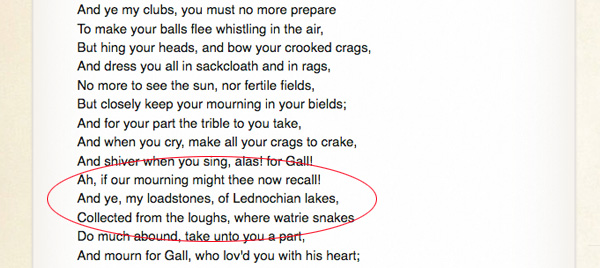
I must admit I don't find either poem an easy read, but the device Adamson uses is to have the various 'curiosities' of George Ruthven's closet mourn for the deceased James Gall. In the passage above, golf clubs get a mention (the poems are an early reference to this sport too), as do curling stones:

'And ye, my loadstones, of Lednochian lakes,
Collected from the loughs, where watrie snakes
Do much abound, take unto you a part,
And mourn for Gall, who lov'd you with his heart'

Now, Adamson realised that his reference to 'loadstones, of Lednochian lakes' might not be understood, so in the margin of the original 1638 book, opposite to the 'loadstones' reference, is printed the two words 'Curling Stones'! In the digitised versions of the poem online this is missing in most cases.

As Gall had apparently loved his curling stones, we can assume that he also loved the sport itself. The evidence suggests then that James Gall was a curler!

In Cant's 1774 edition, the editor removes the reference to 'curling stones' from the margin, but adds an explanatory footnote:

'Lednoch is situated about four computed miles north from Perth, on the banks of the Almond River; about this place the best curling stones were found. The gentlemen of Perth, fond of this athletic winter diversion on a frozen river, sent and brought from Lednoch their curling stones.'

This fits in with what we assume about early curling, that the players obtained their stones from the beds of rivers where they had been shaped and smoothed by the action of the water. However, Cant was writing perhaps 150 years after Adamson had penned the original poems, so just how much he knew about curling and the curlers of Perth at the beginning of the seventeenth century is questionable. But the association with Lednoch does seem secure enough.

So, we have two references to curling stones in Adamson's poems, and later writers were aware of these.  In The Channel-Stane or Sweepings Frae the Rinks, First Series, published in 1883, the two references to curling stones in Adamson's poems, are described. Given that the author of the work (John MacNair) describes the original 1638 book as 'practically extinct', and that he includes the Lednoch footnote, it would seem that he had used Cant's 1774 edition as his reference.

The Reverend John Kerr in The History of Curling and Fifty Years of the Royal Caledonian Curling Club, published in 1898, writes extensively about Adamson's poems. He records that James Gall died in 1620, perhaps only twenty-five years of age, and that Adamson wrote the poems in that year.

Kerr might have had access to the original 1638 book, as well as to Cant's 1774 edition. I say this as the publisher of the History of Curling has typeset the First Muse to show how the words 'Curling Stones' had been placed in the margin of the original 1638 book, as explanation of 'Loadstones of Lidnochian Lakes' (sic), above.

The two references to 'curling stones' described above appear in The Complete Curler by John Gordon Grant, published in 1914. In Beginner's Guide to Curling, by Robin Welsh, published in 1969, the author records just the 'curling stones' mentioned in Adamson's 'The Inventarie of the Gabions in M George, his Cabinet'.

But all these writers missed something very important! It took a young(ish) lecturer at Glasgow University in 1980 to have the idea of looking at the original 1638 book, of which that University had a copy in its Special Collections, and so discover another key reference. The original book actually says that James Gall was a curler! 

In a preface to his poems, Adamson has written the above about James Gall. He was 'a citizen of Perth, and a gentleman of goodly stature, and pregnant wit, much given to pastime, as golf, archery, curling, and jovial company.'

It could not be clearer that here was someone who loved his sport - both golf and curling, and enjoyed fun company. Nearly four hundred years later we probably all know friends who fit this description.

Why hadn't this obvious reference been noted sooner? I suspect that the rarity of the original volume was the reason. Cant's 1774 edition does not include the preface. This important reference to curling - the first time the sport is mentioned in print - must have been overlooked because no-one had studied the original book in detail, relying only on Cant's 1774 edition. How important it is, especially in these days when information is communicated widely online, to check back and confirm the original source material!

The whole preface which shows that James Gall was a curler, appears in this digitised version online of 'The Inventarie of the Gabions in M George, his Cabinet'. 

Two more thoughts. Why did George Ruthven have more than one curling stone in his closet? As far as we are aware, the sport was played in the sixteenth, seventeenth and much of the eighteenth century with one stone for each curler, and the earliest of these stones were 'loofies', without handles. Did Ruthven have stones for different occasions, or did he have spares, to allow friends to play?

Adamson's poems, as well as providing the earliest dated reference to curling and curling stones, give us the names of two Perth curlers - George Ruthven and James Gall. The names should be better known than they are. It is likely that the poems' author Henry Adamson played too - he certainly knew about the sport to have included the mentions described here. 

I am most grateful to the helpful staff of the National Library of Scotland in Edinburgh, and at the University of Glasgow Library. Both places hold copies of the original 1638 book and Cant's 1774 edition. The images from the original 1638 book are from the National Library's copy. The other images are screenshots from online digitised copies or scans from books in the author's library. 

Thursday, September 29, 2016

The 'Boulder Age': When Your Curling Stone Had a Name!

Curling's history can be traced by studying old stones. The earliest curling stones are called 'loofies', and were without handles. In the photo above, David Smith is demonstrating how he thought a loofie from his collection might have been thrown. No ice on this occasion back in 2003, the discussion taking place in the back garden of his home in Troon!

Most loofies that have survived to this day are not as large as David's. They have indentations for thumb and fingers, as above, and were usually light enough to be easily held in the hand. Exactly how they were thrown, or indeed how the sport was played, remains unknown.

But this article is not about loofies, but is about what followed as the sport of curling evolved.

The introduction of a handle heralded the second era of curling in Scotland, probably in the seventeenth century, the game then being played with rough blocks with handles attached, such as in the image above. If the first era in curling history might be called the 'Age of the Loofie', then the next stage in the sport's evolution could be termed, 'The Boulder Age'.

These old stones varied considerably in size and weight. Each player threw one stone, often in teams of eight players aside. Rough though they were, curling stones were prized objects. Some even had names! These reflected their characteristics, or identified them with their owner.

By the time curling clubs were being formed in the early nineteenth century, most were playing with round, dressed stones. Some treasured their old curling stones, even though they were no longer played with. The Reverend John Kerr's book The History of Curling and Fifty Years of the Royal Caledonian Crling Club was published in 1898. Kerr included the names of several clubs who still looked after old stones from the 'Boulder Era', with names. For example, Alyth CC had 'Rookie', 'The Goose', and 'The Deuk'. Blairgowrie had 'The Soo', 'The Baron', 'The Egg', 'The Fluke', and 'Robbie Dow'. Coupar-Angus had 'Suwaroff', 'Cog', 'Fluke', 'Black Meg', and 'The Saut Backet'.

'The Provost' and 'The Baillie' were in the care of the Dunblane CC. The Duns CC had 'Rob Roy', and another called 'The Egg' (presumably different from Blairgowrie's stone of the same name). It was recorded that 'The Guse' and 'Bluebeard' had gone missing. 'The Whaup' and 'The Town Clerk' belonged to Hawick CC, and 'The Girdle' and 'The Grey Hen' to Jedburgh.

Lochmaben had 'Tutor', 'Skelbyland', 'The Craig', 'Wallace', 'Steelcap', 'Bonaparte', 'Hughie', 'Redcap', and 'The Skipper'. Muthill CC had 'The Bible', 'The Goose', and 'The Hen'. Markinch CC had 'The Doctor'. Newtyle CC had 'The Prince' and 'The Kebbuck'.

The table above lists the five Blairgowrie stones.

Kerr's book includes images of what these stones looked like. Top left is 'The Soo', and top right, 'The Baron'. 'The Egg' is in the middle. Bottom left is 'The Fluke' and 'Robbie Dow' is bottom right. All have looped, or double, handles.

The stone in the photo above, beside a modern stone for comparison, is now part of the Scottish Curling Trust's collection, see here. It is called 'The Egg' and is certainly the stone of that name which once belonged to the Blairgowrie CC.

The last stone that Kerr describes in his book is shown above. It was presented to the Royal Club in 1888 by John Wilson of Chapelhill, Cockburnspath, and we can assume that it had been used in that part of the country in years past. It may have had a name before 1888, but, as it was exhibited at the 50th Anniversary meeting of the Royal Club, it became known as 'The Jubilee Stone'. It weighs 117 lbs.

The stone had belonged to John Hood who had died at Townhead in January 1888. Kerr explains, "Mr Hood, it appears, had often seen his father play the stone, and he himself had played it occasionally before dressed stones were introduced. It was sent by Mr Wilson to be preserved in the archives of the Royal Club; and we are sure that generations of curlers will look upon it with interest and astonishment, if not with dismay."

It remains a prized possession of the Royal Club and has been brought out of retirement on occasion and played as the ceremonial 'opening stone' of major championships. 

If I had to pick my favourite named stone, it would be this one. It is undoubtedly from the Boulder Age, although it has been worked on by a mason to give it a triangular shape. Triangular shaped stones were not uncommon, although usually they were not as large as this, which weighs around 110 lbs. They were called 'whirlies', as because of their shape, when hit with another stone, they often just revolved on the spot rather than being driven out of the house! This one is in the care of the Scottish Curling Trust and has been catalogued here, where it is described as "A triangular hammer-dressed stone, weight 110 lbs, presented to the RCCC by Mr A Henderson Bishop in 1938. It was one of the Meigle Grannies and its neighbour was sent to the Montreal Curling Club by Mr Bishop."

This stone is described as 'one of the Meigle Grannies'. I was intrigued. Where had they come from? How had Henderson Bishop acquired them? Were the two 'Grannies' identical? They would not have been a pair, as at the time when they were in use it was 'one curler - one stone'. But if they had been used by members of the same team, they would have been serious weapons on the ice!

Andrew Henderson Bishop was a curling enthusiast, and an enthusiastic collector. I wrote about him here. He put together a collection of curling memorabilia which was exhibited in the Palace of History at the 1911 Scottish Exhibition in Glasgow. In the exhibition catalogue I found 'The Grannies'. They are listed in a collection of 'Curling Stones or Channel Stanes of the Boulder Type' and were desplayed on a platform along the North Wall. They are catalogued separately:

'No 84 Hammer-dressed Triangular curling stone from Meigle, known as 'Grannie'. Weight 101 lbs.

No 85 Hammer-dressed Triangular curling stone from Meigle, known as 'Grannie'. Weight 110 lbs. Nos 84 and 85 were called 'The Grannies'.'

Both stones were 'Lent by A Henderson Bishop'. From this we learn that the two stones were similar enough be be described together as 'The Grannies', although they were not identical, one being somewhat lighter than the other. The catlogue entries give no clue to how Henderson Bishop came to own the stones, other than they had come from Meigle, a village in Perthshire.

Which one went to Canada? And when and why did Henderson Bishop decide to give one away? And where is it now? I don't have the answer to these questions yet, but I am hopeful that the answers will be found!

Other named stones I've come across in books and articles are, 'The Old Cobbler', 'Sleeping Maggie',  'Creche', 'Tom Scott', 'Wellington', 'The Horse,' 'The Kirk', 'The Saddle', 'President', 'Soo', 'The Scone', and 'The Bannock'. No doubt there are others.

Such stones were last used in anger in the early years of the nineteenth century. By then, the size and shape of curling stones was being regulated, first by certain curling clubs themselves, and, from 1838, by the Grand (later Royal) Caledonian Curling Club, the sport's governing body. Rule V, shown above, was adopted by the Duddingston Curling Society in 1804. The introduction of 'circular curling stones' heralded the sport's 'Modern Era'.

The photo of David is from my archive, as is the photo of my hand with a loofie from the Stirling Smith Art Gallery and Museum. Other images are from 35mm slides which date from 1979, when the stones photographed were in a display case at the Central Scotland Ice Rink, Perth. The table is from the History of Blairgowrie, online here. Images of the Blairgowrie stones from the History of Curling are scanned from page 41 of the large format edition. The Duddingston rule V is from An Account of the Game of Curling, by a member of the Duddington Curling Society, 1811.