Monday, September 05, 2016

The Women in the Painting: Scottish Curling Pioneers

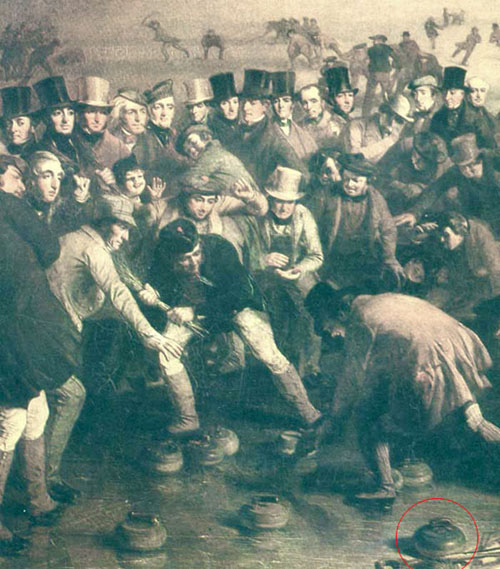
Charles Martin Hardie's painting, 'Curling at Carsebreck', dates from 1898. The image above is just part of the full painting which hangs in a room at Scone Palace, Perthshire. It belongs to the Royal Caledonian Curling Club. The National Galleries of Scotland have a smaller version, thought to be a preliminary sketch, and this can be seen online, here.

Hardie included likenesses of many curlers of the time, and this was discussed by David B Smith in an article about the painting here. I wondered just what contributions the two women in the painting had made to the sport, that they had been selected to be included in it. I have written already about one of the two women in the painting, Henrietta Gilmour, see here. Research on the other, Mrs Maxwell Durham, has led me to realise the uphill battle that the early pioneers of women's curling in Scotland had in becoming accepted within the male dominated curling fraternity in the late nineteenth and early twentieth century.

This detail is from the engraving of the painting published by Doig, Wilson and Wheatley, 90 George Street, Edinburgh, in 1900. The photogravure process had been carried out by the Groupil company in Paris.

Mrs Maxwell Durham is the woman on the left. As Janetta Sprot Stewart McCulloch of Barholm, Kirkcudbrightshire, she had married Thomas Maxwell Durham in Biarritz, France, in 1880. The couple's home was Boghead, near Bathgate. Thomas was a keen curler, a member of the Bathgate Curling Club, and was President of the club when it joined the Royal Club in 1880 (and indeed remained as its President until his death in 1899). Mrs Maxwell Durham became the club's patroness in 1882. She does not appear at first as a member of the Bathgate CC, but it is reasonable to presume she did learn to play on the Bathgate pond.

Then, in the Annual of the Royal Caledonian Curling Club for 1896-97, Mrs Maxwell Durham is listed as an occasional member of the Bathgate club alongside twelve other ladies. These were: Miss Allan, Miss Gordon, Miss M Allan, Mrs Gentleman, Mrs Macnab, Mrs Halliday, Miss Meldrum, Mrs Sloan, Mrs Austin, Mrs Graham, Mrs Cameron and Mrs Kirk.

But by the following year, most of these these ladies, with some others, had formed their own club, the Boghead Ladies Curling Club, which became affiliated to the Royal Club at the AGM on July 8, 1897, election to club membership being 'unanimous'.

As you can see from the club's entry in the 1897-98 Annual, Mrs Maxwell Durham was its President. That Annual also suggests that the club had actually been first constituted in 1895. Janetta Maxwell Durham headed up the Boghead Ladies as its President for five years. Thomas Maxwell Durham died on September 19, 1899, and his obituary is in the Annual for 1899-1900. Janetta did not long survive her husband and died in Bath, England, on January 8, 1902, aged 66. However, the club continued to prosper. Mrs Robert Kirk took over as President in 1902, when it had eleven regular and five occasional members.

The sixteen strong Boghead Ladies Curling Club was the second women's club to join the Royal Club, Hercules Ladies having become affiliated in 1895. David Smith wrote about the Hercules Ladies here. That article has a photograph of eighteen members in front of their new clubhouse in 1899.

Balyarrow Ladies CC became affiliated to the Royal Club in 1898 with eleven regular members, and Cambo Ladies the following year, with fourteen members.

So, by the close of the nineteenth century, Scotland had four women's curling clubs. The inclusion of Mrs Maxwell Durham in the Charles Martin Hardie painting was, I believe, an acknowledgement of the establishment of these clubs.

It is interesting to speculate on the reasons for the formation of these women's clubs. It can be argued that the men did not want to share their activity with the women. Equality on the ice was still a long way off. Even though the four women's clubs were accepted into the roster of the Royal Caledonian Curling Club, they did not, at first, compete against the men's clubs. District Medals were awarded, but these only matched up one women's club against another. One reason for that may have been the fact that the women played with different stones than did the men.

Writing in the 1898-99 Annual, an anonymous author notes, "... there is no doubt the national game has recently made great strides in popularity. The ladies have taken it up, and there are now several ladies' clubs, while a good many clubs admit ladies to membership. The weight of the curling stones for ladies' clubs varies from 25 to 33 lbs."

The author says 'a good many clubs admit ladies to membership', but is that enthusiasm backed up by hard facts? If you take the time to go through the list of clubs and members in a Royal Club Annual of the time, you can indeed find other women who were club members.

One of these clubs was Lundin and Montrave CC, and the reason that women came to prominence there, as we have seen (here), was thanks to Henrietta Gilmour, the other woman in the painting. But what other curling clubs had women members?

In the Royal Club Annual for 1900-1901, the membership of 539 Scottish clubs is recorded, as at September 15, 1900. As noted above, there were four women-only clubs: Hercules Ladies, Boghead Ladies, Balyarrow Ladies and Cambo Ladies. In addition, the Broughty Ferry CC had what appears to be a 'ladies section'. Indeed, the Dundee Evening Telegraph of December 9, 1897, records a meeting of that club where the proposal to admit lady members to the club was considered. After discussion, it was unanimously agreed that they should be admitted and eight ladies were placed on the roll of members. By 1900, this number had increased to 20.

The Balerno CC listed three 'Lady Members' as a category separate from 'Regular' and 'Occasional', as did the Raith and Abbotshall CC with thirteen.

Other clubs listed women as 'Extraordinary Members'. Callendar CC had two such, Couper-Angus and Kettins CC had three, as did Snaigow CC, and Edinchip CC had four.

The Affleck CC (whose secretary lived in Monikie, near Dundee) lists Jessie Walker, Julie D Taylor, Annie M Boase, L Margaret Cox, Jenny I Fraser, Nellie McIntyre and Jane Walker among its occasional members. The Pitlessie CC has Ruth de Pree, Althea Haig, Annie Gilroy, Jane Gilroy, Annie Macdonald and Meg Macdonald as occasional members too.

Family connections were perhaps the reason some women took to the ice. Dunnikier CC listed a Miss Oswald, a Miss Mary Oswald and a Miss Lena Oswald as occasional members. John Oswald, who was likely their father, was the club's President.

Women's names appear very occasionally amongst a club's regular members. The Bowden CC has a Mrs Maxwell Tress listed thus. Her husband was the club's Vice-president. Incidentally, she was also one of the club's Patronesses. The other was a Mrs Laidlaw, who also took part in games as an occasional member of the club. These names are rare examples of Patronesses who were actually curlers themselves.

Patroness of the Penninghame CC was Mrs Lloyd Anstruther who was also a regular member of the club. Another women in that club's roster of more than 80 men was a Miss Williams. There's a story to be uncovered here, I suspect! 

The above list is not intended to be exhaustive, but does illustrate that by 1900 women were on the ice in their own clubs, in their own teams, and also playing with the men, although not in large numbers.

Club membership returns in old Annuals do not tell the whole story. The report, above, from the Dundee Courier of February 13, 1897, records in detail a match between two teams of women from Lindertis and Glamis. These women's names do not appear in the Annual returns of these two clubs in 1897, although the surnames do appear, most likely fathers or husbands.

Women's participation as full members of the sport's governing body faced one more hurdle. At the AGM of the Royal Caledonian Curling Club on Wednesday, July 24, 1901, in the Windsor Hotel, Glasgow, John Jackson, the President of the Glasgow Lilybank CC, proposed the following motion, "That ladies be not eligible to compete in any matches held under the auspices of the Royal Club, unless by arrangement, and against rinks composed entirely of their own sex." The motion was seconded by John Kinloch of Kilmacolm. The success of this motion would have restricted women to only playing against other women's teams in curling's great bonspiels such as the Grand Match, the International Match, and in Province Matches.

It is to the credit of James Gardner (Bathgate CC), the Rev R Menzies Fergusson (the Secretary of Airthey Castle CC), R Scott (Vice-president of Bonhill CC) and Captain R McKill (Blackburn, West Lothian, CC) who all spoke against the motion, that it was not carried. The way then was clear for women to take to the ice alongside the men, and against them, on equal terms, with the full backing of the Royal Caledonian Curling Club. That this did happen as the twentieth century progressed, in Scotland and elsewhere, we shall see in future posts.

We know very little about these women curlers whose names appear in Royal Club Annuals and newspaper reports from more than a hundred years ago. They were curling pioneers, in the male dominated society of the time. I'm wondering if any of their descendents are aware of their curling ancestors, and can provide further information?  

The detail from 'Curling at Carsebreck' is from a photograph of the painting in the author's archive, and the detail from the engraving was found online here. The Boghead Ladies membership is from a Royal Caledonian Curling Club Annual, and the newspaper clipping is from the British Newspaper Archive.

Monday, August 29, 2016

David's Wall

When the new season begins at Ayr Ice Rink in a couple of weeks, curlers arriving to play will be met by this new construction on Limekiln Road, at the car park entrance. It is a wall of curling stones, and a small cairn of stones, in memory of 'The Sheriff', David B Smith!

Some 100 stones were found in the garden of David and Hazel's home in Troon when the task of relocating David's bequest of his curling memorabilia to the Scottish Curling Trust was undertaken on his death last year. These were in addition to the 300 or so stones that were inside the house, which are now safely in store at Stirling.

Andrew Kerr, a Director of Ayrshire Curlers Ltd and David's friend, was one of those who helped in moving the collection to Stirling, a mammoth task. Andrew, and fellow Director, Gemmill Jack, are those who came up with the idea for the wall at David's home curling rink at Ayr, using the stones from the garden.

David's knowledge of curling's history was unmatched. I miss him very much. Hardly a day goes by when I come up with a question to which David would immediately have had the answer. Andrew says, "I too miss David. Many is the night I would bring him home and have a dram together talking about curling matters."

Whereas rare and important curling stones found a place inside their house in Troon, David and Hazel's garden was a 'sanctuary' for old curling stones. No matter how unloved in their previous existence, they found a home at Troon, and, on a sunny day outside, they were a worthy topic of conversation.

And they can continue to be discussed over! Forget for the moment that these stones have no handles, they all have stories to tell. One can ask two questions right off: how old are they, and what type of stone are they made from?

Take, as an example, the three stones on the top tier of the wall in the photo above. All are single-soled stones, and that dates them from before the middle of the nineteenth century. (I use a date of 1850 as roughly when reversible double soled stones were first manufactured.) The stone on the left is the earliest example - the hole in which the handle was seated is off to the side, the handle itself being L-shaped. The earliest of this type of stone would have had an iron handle, as on the stone that adorns the little pyramid of stones accompanying the wall, see above, permanently fixed in place. It may even have been made in the eighteenth century.

The other two are later. The one on the right (of Common Ailsa) and that in the middle (Carsphairn?) are single soled stones, but with the attachment for the handle in the centre of the stone. This was a small threaded iron bolt, the remains still in place in these two examples, onto which the handle would have been screwed. These handles were the earliest with a 'goose-neck' shape, and were removable.

We can date curling stones by reference to the great curling paintings of the nineteenth century. If you haven't already done so, take a trip to the National Portrait Gallery in Edinburgh where the beautifully restored painting of the Grand Match at Linlithgow by Charles Lees now hangs, see here.

The painting depicts the 1848 Grand Match. We can safely assume that the artist painted what he saw. In the detail above, most of the stones are single-soled, with offset handles. But one stands out as different, as I've highlighted. This is a single-soled stone with a centred handle. Such stones may be considered as a fairly short lived phase in curling stone evolution!

If you study closely the earlier famous painting of The Curlers by George Harvey, from 1835, see here, you will also see one odd stone which looks to be of this type.

Here's another from the wall. What stories could it tell of matches played many years ago? Where, I wonder? And who was AW, its proud owner who saw that his initials were inscribed onto it?

David's Wall is a wonderful reminder of a great man. I am sure he would appreciate it if you consider it as more than a wall of 'old stones', but as a reminder of games played, and enjoyed, on outside ice many years ago.

A vote of thanks must go to Andrew Kerr, Billy Howat, Gemmill Jack, Jim Miller, Gavin Morton and Jamie Mason who made it happen. Although Gemmill built the wall, a considerable amount of time and effort was put in by everyone, particularly in moving all the stones!

Photos © Skip Cottage, and my own thanks to Kirsty Letton.

Tuesday, June 21, 2016

The Curlers at Rawyards

'The Curlers at Rawyards' is a nineteenth century painting that shows the sport of curling. It was painted by John Levack in 1857 and deserves to be better known than it is at present. It is a large oil on canvas, in the care of North Lanarkshire Council and CultureNL, and is currently on display at the Summerlee Museum of Scottish Industrial Life in Coatbridge, Scotland. It can be found online here where a larger image can be studied in more detail than the small one above.

I knew of the painting but, until recently, I had not realised just how big it is. It is one thing to see the image on screen, or in a book, but it is quite another to see it 'in the flesh'! It is around twelve feet by six feet, with the frame. It's huge. At Summerlee, it is is contained in a large glass case. Here I am standing beside it. The idea was to give the scale, but because the painting is about a foot back from the protective front glass, it still appears smaller than it really is!

In the years before photography, paintings can tell us something about how the sport was played. If we assume that the artist painted exactly what he saw in the winter of 1855-56 (when it is thought the match depicted was being played), we can learn something about the sport at that time.

Importantly, the stones in use have goose-necked handles, centred on the stones which presumably are double-sided, made to be reversible. These stones are quite different from single-soled stones, such as those seen in 'The Grand Match at Linlithgow' which was painted just ten years earlier by Charles Lees, see here. I always have in my mind that the middle of the nineteenth century was when double soled stones with goose-necked handles began to replace single-soled stones.

John Levack has depicted the stones at Rawyards in different colours, and we know that in the nineteenth century, different types of rock were used for making curling stones, see here.

There are two games taking place, one in the foreground, and the other on a sheet set at an angle to the first. There is no doubt that play is four-aside. By 1857 most curling clubs were playing matches with four players on each side, playing two stones each, as recommended by the Royal Caledonian Curling Club. Some clubs were still adhering to eight-aside play, but not that illustrated here.

The curlers are all depicted with broom cowes, rather than hair brushes. Even some of those just watching the play are carrying brooms.

It has been said that the painting shows curling in an industrial landscape, but this is hardly the case. In the background, there is a chimney stack and winding gear of a local colliery, of which there were many in New Monkland.

The variety of bottles and the baskets on display indicate that the 'inner man' was being looked after!

When I first looked at the painting online I wondered who the various personalities in the painting were, and why the artist had included them in his composition. When I saw the painting on display I was excited to see that the most prominent figures are all named in little plaques attached to the frame.

I have copied these out, as best I could sitting on the museum floor, with my nose pressed up against the glass case! Those named are:

Thomas Chapman of Commonhead
Claude Storrie (Airdrie)
John Fram (Airdrie)
Robert Mitchell (Airdrie)
James Arthur (portioner, Airdrie)
James Waddell of Whinhall
Baillie Longmuir (Airdrie)
Peter Thomson (baker, Airdrie)
Henry Walker (coalmaster, Airdrie)
James Taylor (baker, Airdrie)
Provost JT Rankin of Auchengray
David Mitchell (banker, Airdrie)
John Davidson of Broomfield
James Thomson (architect, Airdrie)
James Boston (flesher, Airdrie)
Robert Graham (farmer, Rawyards)
John Dalziel (banker, Airdrie)
Patrick Rankin (junior) of Auchengray
Patrick Rankin of Auchengray
John Russell of Eastfield
John Aiton (town clerk, Airdrie)
Gavin Black of Rawyards
James Mochrie (Airdrie)
James Forbes (Royal Hotel, Airdrie)
John Russell (merchant, Airdrie)
William Whyte (writer and registrar, Airdrie)

In all, twenty-six figures are identified in the painting, including an architect, a baker, a banker, a farmer, a hotelier, and the town clerk! James Arthur was a 'portioner', the owner of land, previously divided amongst co-heirs. John Fram should probably be John Frame. Note that there are two John Russells on the list.

It is possible too, to identify the team members 'in action' in the scene. Thomas Chapman has delivered his stone. Gavin Black is directing the play. Claude Storrie and James Waddell are the sweepers. 

That's Gavin Black of Rawyards in the prime position in the painting. The pond, on his land, was home to the New Monkland Curling Club. Black was among the keenest members of the club.

Evidence for this can be found in the Glasgow Herald of March 10, 1854, which records a club dinner in Forbes's Hotel in Airdrie. James Thomson Rankin was in the chair. That's the Provost JT Rankin in the 1957 painting, the striking figure in the kilt! The dinner was in honour of Gavin Black of Rawyards, and he was duly presented with 'a massive silver claret jug'. This had the inscription, "Presented by the members of the New Monkland Curling Club, to Gavin Black, Esq, of Rawyards, as a token of their esteem and respect for him as the leading curler in the club, and as a grateful acknowledgement for the facilities which he affords them in curling - Airdrie, 3d March, 1854."

The newpaper reported that, "Mr Black replied in a speech full of manly feeling and kindly sentiment, assuring his brethren of the New Monkland Club that it afforded him much pleasure to give them the use of his loch at Rawyards."

The New Monkland Curling Club was formed in 1842 and admitted to the Royal Caledonian Curling Club in 1849. It likely took its name from New Monkland parish.

In the Royal Caledonian Curling Club Annual for 1856-57, the Patron was James T Rankin, and the President was Gavin Black. The secretary was James Thomson. He is featured in Levack's painting, and his plaque records that he was an architect. Of the twenty-six named persons in the painting, twenty-one can be found among the regular members of the club listed in the 1856-57 Annual.

In the years after the painting was completed, the club must have encountered problems of some sort. Its list of members appears in the Annual for 1861-62, with John Dalziel now the President, but there's no list of members the following year. Whatever the reason, the New Monkland club did not reappear in the Royal Club's listings again until the Annual for 1877-78, when it is recorded that it had been admitted to the Royal Club in 1877. The regulations of the Royal Club at that time stated, "If any Club shall fall three years in arrear of its annual fees, it shall be struck off the lists of the Royal Club, and not reponed except as a new Club."

But from the names of the forty-nine regular members in 1877, it was most definitely the same club, and must have had a continued existence, albeit not as a member of the Royal Club. Indeed, one can find in the Glasgow Herald of January 31, 1871, the record of a match between the New Monkland and Slamannan clubs at Rawyards, six rinks aside, on January 28.

In the absence of the old minute books it is not possible to say why the New Monkland club had not continued to be a member of curling's governing body. But when back in the Royal Club family, the New Monkland Curling Club teams went on to win the Grand Match Trophy on consecutive occasions in 1886 when the Grand Match was held twice, in January and then in December that year, at Carsebreck.

Where was Rawyards? The Ordnance Survey map, surveyed just a couple of years after the painting was completed, shows the curling pond clearly. The area is to the east of Airdrie. Rawyards was the name of the main house, and there was also a Rawyards Farm.

There is an indication of a small building on the western side of the pond.

And in the painting, there is also a building, and this is surely the club's curling hut where stones and other curling paraphernalia could be stored.

A later map from 1899 shows that the pond may have been modified somewhat, but the curling hut (highlighted in blue) stands out at the end of a track leading from the boundary road.

If you visit the area today, you can find the foundations of a small building, above, where the map predicts it should be. This may have been a later building than that in existence in 1857, but built in the same place. With this evidence and study of the local topography today, it is clear that the artist has taken his point of reference from somewhere on the north side of the pond, and is facing south. The red X on the map above roughly marks the spot!

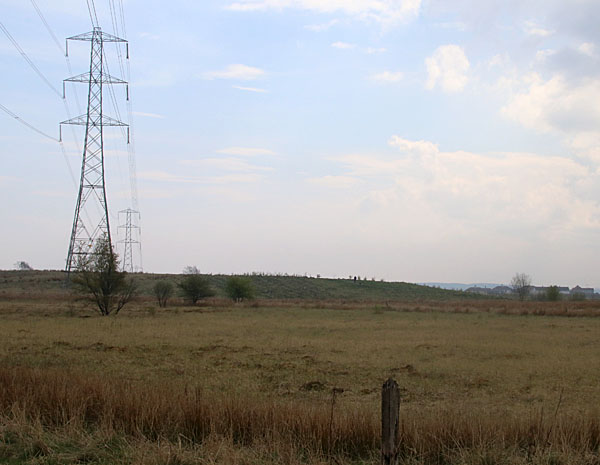
There's no open water nowadays at Rawyards, but where the curling took place is still a marshy area within a newly established community woodland. It's a peaceful place to visit, although, as seen in this photo, it is overlooked by electricity pylons. This view is roughly in the direction that the artist was facing.

I do not know when curling was last played on the Rawyards pond, but the above report from the Kirkintilloch Herald shows that it was in use in the severe winter of 1895, the New Monkland club hosting visitors from Kirkintilloch.

The history of the painting 'The Curlers at Rawyards' raises some interesting questions. As mentioned above, it now belongs to North Lanarkshire Council following the 1996 local authority reorganisation. Monklands District Council, which held the collection from the original Airdrie Museum collection, was incorporated into NLC Museums and Heritage service, along with Motherwell and Cumbernauld and Kilsyth District Councils. Jenny Noble, who is the Social History Curator with CultureNL, suggests that the Rawyards painting, and others by John Levack, were donated to Airdrie Museum in the post-war period, possibly as late as the 1970s, as they weren’t mentioned in a 1936 list of paintings, nor the museum’s 1940 wartime precautions. Jenny says, "Unfortunately we have not as yet been able to locate any acquisition details."

The 'Curlers at Rawyards' was conserved in 1995 and has been on display at Summerlee since the exhibition hall refurbishment was completed in October 2008.

Who commissioned the work, back in the 1850s? One possibility is Patrick Rankin of Auchengray. Three generations of the Rankin family are depicted in the curling painting, and John Levack had previously painted a group portrait of that family, see below.

Jenny Noble provides the following information. "The Rankin family were prominent in Airdrie life from the later 18th century and through most of the 19th century. Patrick Rankin (1790 - late 1860s was initially of Mavisbank; later Auchengray near Caldercruix. He was a leading land and property owner in Airdrie and surrounding district. He was also a partner in Langloan Ironworks. His son, James Thomson Rankin (1819 - 1861), was a very progressive Provost of Airdrie from 1848 to 1856. He also founded the solicitors' firm Rankin and Motherwell. The Rankin family were related through marriage to many of the leading families in New Monkland.”

It is also possible that the painting might have been commissioned by Gavin Black of Rawyards, see above, the President of the New Monkland CC on whose land the pond was.

John Levack is known as an accomplished portrait painter, although he has not left a large body of work. 'The Curlers at Rawyards' is probably his best known painting, together with that of 'The Rankin Family' (see here) which is also on display at Summerlee. Some of his other work can be found online here, here, and here.

John Levack seems to have been born in Wick. His details on the Art UK website, here, says he was born in 1823, but I think this is incorrect. The biography of the artist held at Summerlee sugests that he was born in 1828, and that date is the more likely, given the ages stated in other records of his life. This being the case, he would have been in his late 20s when he painted 'The Curlers at Rawyards'.

According to this page, Levack became a mason when in he came to Airdrie in the 1850s. He joined the New Monkland Montrose Lodge 88 in 1860 and was a regular attendee in the early 1860s. He was appointed governor of the New Monkland poorhouse in 1864.

On November 24, 1867, he married Agnes Laughlan, a 26 year old seamstress from Airdrie, whose father, James, by then deceased, had been a lawyer. Levack's age in the marriage record is given as 40 which fits with him being born in 1828, rather than 1823. 

Unfortunately, the couple did not 'live happily ever after'.

The above does not make for pleasant reading. As a result of this attack on his wife on August 27, 1873, Levack appeared at the Sheriff Court in Airdrie on October 7. He pled guilty and was sentenced to three month's imprisonment with hard labour. The Sheriff considered 'extenuating circmstances' before deciding on the sentence, according to the report in the Glasgow Herald on October 8. What were these 'extenuating circumstances' I wonder?

On his release from prison, Levack seems to have moved away from Airdrie, to the Kinning Park area of Glasgow. On Monday, October 5, 1874, the Edinburgh Evening News reported, "An artist named John Levack, who had been in a desponding state of mind for some time, was found at his home in Henderson Street, Glasgow, on Saturday. Three phials which had contained laudanum were found by his bedside, and it appears that death had resulted from an overdose of laudanum. He must have been dead about eight days."

Henderson Street in Kinning Park is now Howwood Street.

These days the adjective 'desponding' is not in common use, having been replaced by 'despondent'. It would seem that Levack had suffered from depression. Laudanum, a tincture of opium, was in common use in Victorian times. Read the history of its use here. As Levack's body lay undiscovered for many days, it can be assumed he was living alone. It was a sad end for someone who had been so talented, and popular, earlier in his life.

The newspaper report of Levack's assault on his wife had said 'It is doubtful if Mrs Levack will recover'. Evidence that Agnes did survive is that her signature appears on her husband's death certificate, and on that of her mother who died in 1879.

I thank Jenny Noble, Social History Curator with CultureNL, for information about the painting, the artist and the Rankin family. The staff at the Summerlee museum could not have been more helpful. Do visit! Thanks go to Lindsay Scotland for taking the photo of me beside the painting, and for helping to decipher the little plaques on the frame. The other photos of the painting, and of Rawyards today, are mine. Apologies for the various reflections from the glass of the case in which the painting is housed. The British Newspaper Archive again proved invaluable in researching information about the artist, and the National Library maps website continues to be a wonderful resource for locating old curling ponds.

Tuesday, March 08, 2016

When World Junior Curling Came to Glasgow in 1991

by Bob Cowan

In 1991 these eight young curlers had just won the Scottish Junior Curling Championships and were getting ready to represent their country at the Worlds. They were (back, left-right) James Dryburgh, Fraser MacGregor, Alan MacDougall (skip), Colin Beckett, and (front) Anne Laird, Gillian Barr (skip), Claire Milne and Janice Watt.

I found myself thinking of them on Sunday as the World Curling Federation's VoIP Defender World Junior Curling Championships 2016 got underway at the Taarnby Curling Club in Denmark. Back in 1991, our Scottish representatives didn't have too far to travel. The event was held in Glasgow. It took place March 9-17, 1991, at the Summit Centre. Twenty-five years ago - how time flies! Sadly the Summit Centre is no more. The rink had a short life, opening in 1986 and closing in 1998.

You can find all the statistics from the 1991 World Juniors on the World Curling Federation's Historical Results pages, here. I wonder why the sponsor, the Royal Bank of Scotland, doesn't get a mention thereon?

Rather than talk just about the event, I want to say a bit about the programme, above. As most collectors of international curling programmes know well, they often contain little more than the draw, the team names, and a number of 'welcome messages'. The 1991 programme contained much more than that. It included magazine-style articles, and hopefully was considered to be value for its £2 cover price. The forty pages plus covers were printed by Brown, Son and Ferguson Ltd.

The Executive Editor was Christine Stewart. She recruited me to help put the programme together. This was my first foray as the 'editor' of anything. I had no inclination back then that ten years later I would become the Editor of the Scottish Curler magazine.

Christine also involved Rod McLeod to design the programme, and he did a wonderful job. For me it was a great privilege to work with such a talented, fun and enthusiastic person. Rod McLeod was one of Scotland's foremost cartoonists, producing daily his 'take' on whatever was happening in the sporting world. This was football mostly, but he could also draw perceptive cartoons on the important news stories of the day. His cartoons, simply signed Rod, had a big following. He was a curler too, a member of the Nondes club. Rod died in 2004 and is still greatly missed.

Rod drew this cartoon to illustrate page 5 of the programme, which had a 'who's who' of the local host committee. Leslie Ingram-Brown was the chairman, and his team included Ian Addison, Michelle Cunningham, Graham Davidson, George Gibb, Bruce Lindsay, Robin Shand, Bob Smith and Christine Stewart.

The event programme included six welcome messages. These were from George Younger, Chairman of the Royal Bank of Scotland, the main sponsor; Councillor David M Sanderson JP, Convenor of Strathclyde Region; Susan Baird OStJ JP, The Rt Hon The Lord Provost of Glasgow; RC Miquel CBE, Chairman of the Scottish Sports Council; Gunther Hummelt, the President of the International Curling Federation; and from Leslie Ingram-Brown, Chairman of the Host Committee.

The programme included four pages on the history of the Uniroyal and Goodrich-sponsored championships. The year 1991 marked the end of that sponsorship. The first Uniroyal World Junior Mens Championship had been held in 1975, although the origins of the event went back much further, see here. The first official Goodrich World Junior Women's Championship had been held in 1988, growing from a European Junior Championship that dated from 1983. That 1988 competition in Chamonix was the only time that the junior women's event was staged separately. Both men's and women's events had been staged together since 1989 in Markham, and still are together today. Of course, no history of the Uniroyal would be complete without considerable mention of a certain Paul Gowsell, and his photo spanned pages 6 and 7 of the programme.

Elizabeth Paterson-Brown wrote about the International Curling Federation (as the WCF was called then) and junior curling, in an article titled 'The Way Forward'. Jane Sanderson wrote about 'Little Rockers and Mini-swingers'.

Doug Gillon penned three pages 'I Was There' recounting highlights of curling history. I wrote about 'Collecting'. Robin Welsh wrote about 'The Murray Trophy', the trophy still awarded to the winners of the Scottish Junior Men's Championship.

Gordon Fenton recounted the Royal Bank of Scotland's involvement with the sponsorship of curling. Back in 1991, the banks were much respected organisations, and the Royal Bank of Scotland, the Bank of Scotland, and the Clydesdale Bank, had all sponsored major curling competitions.

Then there was a 'Spotlight on the Umpires'. Roy Sinclair was chief umpire and his team included Alex Torrance, Isobel Torrance and Marjorie Kidd.

David B Smith's article on decorated curling stones had the title 'Flower Power'!

John Brown submitted some 28 quiz questions about the World Junior Championships and curling history in general. In the days before Google these were not easy. But John did provide the answers!

Page 40 of the programme had 'Acknowledgements and Thanks' and a space for autographs. I wonder if anyone collected the autographs of all the players?


Here are the first group of the junior men's teams.

Ten countries competed in 1991.

This page illustrates one of the problems facing the host committee back then. In the days before the internet and email, and before digital cameras, it was not easy for national organisations to transmit team photographs in time to be included in the programme. The space was there for the Italian women's team details, but the programme had to go to print before these were received. Fortunately, the WCF Historical Results database has this information, see below.

The draw occupied the centre double page spread. You can find the results of every junior men's game here, and the junior women's results here.

As far as I am aware there is no video footage or film of the event, but I would be pleased to be proved wrong! (Added later: Apparently video DOES exist. BBC television covered the finals. Perhaps I can post clips of this in a future article. Watch this space!)

I have kept the various reports of the event which appeared in the local newspapers, and these make interesting reading. I had forgotten that the teams were accommodated in the homes of local volunteers. Visiting fans complained about the over-use of air horns by the home supporters, some of whom were banned from beating drums as the chielf umpire was unable to hear his hogline umpires' calls on his walkie-talkie radio. And it is recorded that the Scottish Sports Council's anti-doping team were on hand for the first time at an international curling event.

Who won? Eva Eriksson's Swedish team defeated Nicole Strausak's Swiss side 5-4 in the women's final. Gillian Barr's team had lost to Strausak in the semifinal. On the men's side MacDougall's Scotland beat Noel Herron's Canadians 6-4 in the title match.

If anyone has photos of the winning teams with the trophies, I would be pleased to include these here.

Off the ice, pin collectors had two event pins to add to their collection. This was the 'official' pin, an early example of a plastic coated badge which has disoloured somewhat with age.

And we liked this one!

So, why don't I wrap up this nostalgic look back at the young curlers who competed in 1991 with a John Brown style quiz. Have a look at the list of competitors in 1991, below, taken from the WCF records, as well as the programme. Who went on to further international success in the years that followed? Can you spot the future World and Olympic Champions on the list? How many are still competing at top level?

Scotland's fifth player Graham McIntyre played in the last round robin game but does not appear in the records. So, are other names missing? Any other mistakes?

JUNIOR MEN
Scotland: Alan MacDougall, James Dryburgh, Fraser MacGregor, Colin Beckett
Canada: Noel Herron, Rob Brewer, Steve Small, Richard Polk, Peter Henderson
Switzerland: Dominic Andres, Michael Schupbach, Marc Steiner, Mathias Hugh, Stefan Heilman
USA: Eric Fenson, Shawn Rojeski, Kevin Bergstrom, Ted McCann, Mike Peplinski
Denmark: Torkil Svensgaard, Ulrik Damm, Kenny Tordrup, Lasse Damm, Peter Bull
Germany: Markus Herberg, Marcus Räderer, Felix Ogger, Martin Beiser, Markus Messenzehl
Sweden: Tomas Nordin, Örjan Jonsson, Stefan Timan, Jan Wallin, Peter Lindholm
Norway: Thomas Due, Torger Nergård, Mads Rygg, Johan Høstmælingen, Krister Aanesen
France: Jan Henri Ducroz, Spencer Mugnier (skip), Sylvain Ducroz, Thomas Dufour, Philippe Caux
Italy: Marco Alberti, Alessandro Lettieri, Rolando Cavallo, Gianni Nardon, Stefano Gottardi

JUNIOR WOMEN
Sweden: Eva Eriksson, Maria Söderkvist, Åsa Eriksson, Elisabeth de Brito, Cathrine Norberg
Switzerland: Nicole Strausak, Ursula Ziegler, Katja Matties, Claudia Affolter, Helga Oswald 
Canada: Atina Ford, Darlene Kidd, Lesley Beck, Cindy Ford, Danita Michalski
Scotland: Gillian Barr, Claire Milne, Janice Watt, Anne Laird 
USA: Erika Brown, Jill Jones, Shellie Holerud, Debbie Henry, Heather Baumgardt
Denmark: Dorthe Holm, June Simonsen, Margit Pörtner, Helene Jensen, Angelina Jensen
France: Karine Caux, Christel Fournier, Géraldine Girod, Tania Ducroz, Helene Ducroz
Norway: Cecilie Torhaug, Darcie Skjerpen, Anna Moe, Marianne Vestnes, Gøril Bye 
Italy: Daniela Zandegiacomo, Carla Zandegiacomo, Giulia Lacedelli, Violetta Caldart 
Germany: Katrin Mayer, Julia Eckert, Steffi Gabler, Anja Messenzehl, Monica Imminger

In the women's event I've listed the players' names as they were in 1991, and of course some have changed in the intervening years. The WCF database lists the players with their married names. Personally, I think that is wrong. In the records of an event, the players should be identified by their names at the time.

The top photo is from the front cover of the February 1991 Scottish Curler. Other images are from the programme.

Sunday, February 21, 2016

The first curling songs

The earliest printed booklet specifically about curling is from the eighteenth century. It is a collection of songs.

Songs for the Curling Club, held at Canon-Mills, was published in Edinburgh in 1792. The author, or compiler of the songs, is not known. Edinburgh was home to the Canonmills curling club. The location of Canonmills Loch, where the club played, is described here. It was drained in the middle of the nineteenth century.

The original publication is extremely rare. I've cheated a little. The above frontispiece is not from an original 1792 book, but is from a reprint, this one:

This I am very happy to have in my curling 'library'. It is one of only 250 copies printed in 1882 and, as well as Songs for the Curling Club, contains another rare curling work, An Account of the Game of Curling, dating from 1811.

The preface to this reprint of the two earlier books states, "As works relating to Curling or any way connected to it are scarce, and not readily procurable, two of the scarcest of their kind have been selected for re-publication with the view of bringing them within reach of the numerous admirers of this agreeable and exhilarating pastime." J M, Edinburgh, February, 1882. 'J M' was Captain John Macnair, who, in the following years, put together the four volumes of The Channel-Stane or Sweepings frae the Rinks.

In 2016 the content of the volumes is readily available to everyone, as facsimiles can be purchased online from a number of different sites.

There are six songs in Songs for the Curling Club: The Curlers March; The Blast; The Origin of Edinburgh Castle; The Three Open Winters; The Welcome Hame; and The Choise. I recently asked myself the question, "What, if anything, do these songs tell us about the sport in the eighteenth century?" Here are a few thoughts. 

The first printed song is 'The Curlers March' and begins ...

Tho' Sol now looks shyly, and Flora is gone
To Mother Root's lodgings, of turf, mud, and stone,
When they two together,
Throughout the hard weather, 
Unsocial as Vestals, keep house quite unknown.
Unlike are the Curlers, now more social grown,
Unlike to recluses who winter alone,
With mutual friendship glowing, to action prone,
Forth come they
Brisk and gay
All in flocks like sons of the spray,
Inspired by the sound of the curling stone!

There are four more verses, in a similar vein, the last referring to post-game traditions of having a meal for 'beef and greens', and drink - a toast 'To all Curlers keen'.

Perhaps someone reading this can help with what is puzzling me about this song. It is apparently to be sung to the tune 'Princess Royal'. This is a popular piece, which you can find online here, here, and in lots of other places on a variety of instruments. But I cannot fit the words to this tune. Can you? Is there other music called 'Princess Royal', or has it just been wrongly ascribed? And if so, what tune might 'The Curlers March' have been sung to?

The tune 'Princess Royal' can also be danced to, as seen here. This may be the first ever connection, however tenuous, between curling and morris dancing!

This page suggests that 'The Curlers March' was played (and sung, perhaps) during the ceremonial procession of Edinburgh magistrates and councillors on the way to Canonmills Loch.

Returning to Songs for the Curling Club ...

In 'The Blast', the second song in the book, we find the lines

As we mark our gog,
And measure off our hog ...

'Gog' is another word for the tee, and the 'hog' of course is the hogline, both key in setting out ice for a game of curling in the days long before circles were inscribed on the surface. This poem has the line, seen in context above ...

With our nimble brooms ...

which shows that sweeping was a part of the game in the eighteenth century.

Besoms (brooms) are also mentioned is 'The Origin of Edinburgh Castle', which alludes to the games evolution and equipment improving. Three verses end as follows ...

When curling was in infancy
An' stones war no fine.

When curling was in infancy
An' handles no fine.

When curling was in infancy,
And besoms no fine.

In 'The Three Open Winters' the author bemoans the mild conditions that prevented curling from taking place. The chorus reads ...

Alake my walie curling-stanes
Ha'e no been budg'd thir winters three,
'Tween the rains plish plash an' a fireside's fash,
They have dreary winters been to me. 

('Walie', or 'wallie', in Scots, is used here, I believe, to mean 'fine' or 'excellent'. I rather like the concept of 'wallie curling stones', not to be confused with 'wallie dugs'.)

In 'The Choise', part of the last verse reads ...

But Curlers chase upon the rink, 
An learn dead stanes wi' art to jink,
When tir'd wi' that gae in an' drink,
An' please them wi' the skinking o't.

To 'skink' is to pour drinks. I think this shows that some things haven't changed in the traditions of curling since 1792!

Singing may not be such an important aspect of curling these days as it once was, although I trust that at the Henderson Bishop dinner next week at Lockerbie, the ladies will, as usual, be in fine voice.

Bob Cowan

Monday, February 08, 2016

Pondhunting 'Cairnie ponds' and 'Sprinkle rinks'

It's been a while since I wrote about the project to map the 'Historical Curling Places'. See that post here. The project continues to thrive, and I enjoy the small part I play in it. Although begun by David Smith, nowadays Lindsay Scotland and Harold Forrester take the lead, and contributions from others are always welcome. Perhaps there is an old curling pond near where you live. You could become a 'pondhunter'! What does 'your' pond look like today?

It is exciting that the project has no finite 'end'. Yes, perhaps one day all the places where curling has taken place will be mapped. But for each place, other questions arise. Who played there? What significant games were played there? If the place was a curling pond, was it constructed by a local club? If so, when? How long did it last? What costs were involved in its construction and maintenance? When and why did it fall into disuse? Are there newspaper reports of play there? Are there photographs of the venue in use?

In trying to answer even some of these questions, we stray away from just a mapping exercise, and enter the realms of social history, and a way of life long past.

There's one question that I've not posed above, that is, what type of curling place does each entry in the database, or dot on the map, represent? It is apparent when studying the maps, see here, that there is great variety in the places that curlers in the past found to pursue their sport.

It is possible to classify these places into a number of different categories. In past times curlers found themselves on ice of the following types: natural water, managed water, maintained curling club ponds, Cairnie-style shallow ponds, and tarmac rinks.

I've set out my attempt at a classification below. I've tried not to use the term 'artificial'. That's because it is just too general and 'artificial' can apply to a deep water pond with sluices to regulate the water depth, to a Cairnie-style shallow pond, or to a tarmac rink. 

Let's expand on these a bit further.

Curling will have begun on ice that formed over 'natural water'.  Everyone is familiar with the outdoor 'Grand Match', the last of which was held in 1979 on the Lake of Menteith. But there are many references to venues that are somewhat smaller, or even to frozen rivers. Probably a safer option was the frozen surface of a flooded field, and my first outdoor experience was on such a venue near Gateside, Beith. I remember it well.

1. Natural Water
1a. Loch or lake
1b. Lochan or tarn
1c. River
1d. Flooded field

2. Managed Water
2a. Canal
2b. Mill pond
2c. Fish pond
2d. Reservoir
2e. Ornamental pond in estate grounds
2f. Ornamental pond in public park

3. Maintained curling club ponds
3a. Natural shape club curling pond, with managed water intake and sluice or drain
3b. Regular shape constructed club curling pond, with water intake and sluice, perhaps with an embankment or dam

4. Cairnie-style shallow ponds
4a. Clay floor
4b. Concrete/cement floor
4c. Wood floor
4d. Bitumen/asphalt/tarmacadam floor
4e. Metal floor

5. Tarmac rinks
These are also known as 'sprinkle rinks', and were constructed in the early twentieth century. More on these below.

Aside from these five categories, there are also 'packed snow' rinks. These were (and are still) found in Switzerland and New Zealand, but rarely, if ever, in Scotland. There are instances where tennis courts and bowling greens have been flooded in winter time. And of course there have been outdoor rinks with artificial refrigeration, usually of a temporary nature around Christmas time, for skating and curling.

In the classification scheme above, the difference between categories 4 and 5 can cause confusion.

Cairnie-style ponds are shallow ponds with a small border to retain water to a depth of a few centimetres. They are named after John Cairnie of Largs. In 1833 he published a book, Essay on Curling and Artificial Pond Making, in which he describes fully his efforts to provide an ice surface which would allow him to curl when natural lochs or deep water ponds were not bearing. Some pages of his book, facsimile copies of which are readily available, refute claims by the Reverend John Somerville of Currie who sought credit for the invention. I resist the temptation to lay out the arguments here! However, Cairnie made his pond work, and there are many reports of play on it, for example:

This clipping from the Edinburgh Evening Courant of January 17, 1829, predates by some four years the publication of Cairnie's book, and shows that the importance of his invention was being recognised even then. 

You can see what Cairnie's pond in Largs looked like, in a painting which belongs to the Royal Caledonian Curling Club, here. John Cairnie of course became the Club's first president on its formation in 1838.

The bottom of Cairnie-style ponds had to be be of a material which would retain water. Cairnie himself experimented with a number of materials, but over the years others successfully constructed ponds with floors of clay, cement, concrete, tarry materials, wood, or even iron plates. The water depth of a Cairnie-style pond is usually only 3-4 cm. The floor does not need to be perfectly flat as the water finds its own level. Given a sharp frost, the water freezes completely, providing complete safety, compared with the dangers of curling on insufficiently strong ice floating above several feet of water. However, Cairnie-style ponds did not give the characteristic sound of the stones travelling across ice on 'deep water' places, which gives rise to curling being referred to as the 'Roaring Game'.

This is a photo taken recently of a Cairnie-style pond at Tarfside, in Glen Esk, Angus. Although dating from the end of the nineteenth century, it was renovated a few years ago. See play on the pond here and here.

Nowadays it is a wooden edge that keeps the water in place, and the pond appears to have a concrete base. Sadly, there has been no play on the Tarfside pond so far this winter.

But another Cairnie-style pond has seen considerable activity. The Highland Curling Club's pond at Kingsmills, Inverness, has four sheets, with a clay base. See photos on the club's Facebook pages here.

Now to category 5. 'Tarmac', short for tarmacadam, is mentioned frequently in reports of curling in the early twentieth century. What is tarmac, exactly? Defining the word's meaning is not so simple, see here.

The word is associated with John McAdam, who was born in Ayr in 1756 and died in Moffat in 1836. He is credited with inventing the 'macadam' road surface, namely that roads should be higher than their surroundings to achieve drainage and constructed with a base of large rocks, then with smaller stones, the layers tied together with fine gravel. You can read McAdam's 1819 paper Practical Essay on the Scientific Repair and Preservation of Roads online here.

It was in 1901 that Edgar Purnell Hooley patented a method for mixing tar and aggregate to go on top of a macadamised surface, compacting the lot with a roller. The various recipes for 'tarmac' date from this time.

The material was certainly used as a base for Cairnie-style ponds, but gave its name to a new type of curling place - the 'tarmac' or 'sprinkle' rink.

The Complete Curler by J Gordon Grant, published in 1914, suggests that the first tarmac curling rink was made in 1903, and between then until the book was written 'hundreds of tarmac rinks have been constructed throughout Scotland and the northern half of England'. He describes the depth of the ice on a tarmac rink, as 'only the mere skin of about the thickness of a sixpence, and this is obtained by spraying water lightly over the rink, which instantly freezes'.

So a Cairnie-style pond has a few centimetres of ice, whereas the thickness of ice on a tarmac rink is only one to two millimetres.

As there is no depth of water on a tarmac rink to allow it to find its own level, it follows that the stretch of tarmac on the base of a tarmac rink had to be perfectly flat.

An early reference to 'tar macadam' in the construction of a curling rink can be found in the Scotsman of November 22, 1904. This says, "The first game of the season, and the first game on Mr Stoddart's new private artificial pond at Howden, was played yesterday forenoon between rinks skipped by Mr James Wyllie, New Calder, and Mr Robert Maconachie, Mooralmond. After a keenly contested game which lasted two and a half hours, the score stood fifteen each when, on account of the fall of snow, the order to cease play was given. The ice was in splendid condition, and the new pond in every respect gave evidence that the tar macadam system of artificial curling ponds is a success."

James Edward Stoddart was in his early fifties, the head of the household at Howden, and living there with his wife Agnes, his daughter, Agnes Young, and three servants. He had been President of the Mid-Calder curling club since 1896. His wife was a 'Patroness' of the club. James Stoddart must have been a really keen curler to have gone to the trouble and expense of constructing a tarmac rink on his property, one of the first to do so. He deserves to be remembered as a curling 'pioneer'!

On November 28, 1904, the Scotsman reported, "Mid-Calder. Members of this club had splendid play every day last week on Mr Stoddart's private artificial pond at Howden. This pond has proved in every way the advantages of the tar macadam system of artificial curling ponds. On Tuesday, after two and a half hours play in the forenoon, the ice became somewhat 'bauch' and after lunch the curlers engaged in a game of bowls on one part of the pond while the other part, which had been sprayed, gained time to freeze. Curling was then resumed the same afternoon."

The reference to playing bowls on the same surface as the curling rink is interesting. A tarmac surface that could have a use for other sports in the summer months would have been a sound investment. 

The Ordnance Survey 6 inch to the mile map published in 1908 shows the house, and a feature, highlighted, which is likely to be the tarmac curling rink. Howden House still exists, see here, and is surrounded now by Livingston new town.

As luck would have it, we may even know who constructed the rink at Howden. Andrew Scott, whose letterhead is above, was based at Watson's College Pavilion, Myreside, Edinburgh. He wrote in November 1905 to a prospective client, although it is not clear who this client was. Scott's letter says, "Your committee has visited the pond at Mid Calder belonging to Mr Stoddart. If the directors were satisfied it was suitable for those games (curling and bowls), I willingly guarantee you a pond even better than that."

This could mean that he had constructed the rink at Howden himself, or it could mean that he knew all about that rink but thought he could do an even better job in constructing a similar one. 

Scott's business seems to have flourished. The Arbroath Herald and Advertiser for the Montrose Burghs on November 19, 1909, describes how the Arbroath curling club's Cairnie-style pond had deteriorated and been converted to a tarmac rink, the work carried out to everyone's satisfaction by Andrew Scott. 

The Royal Caledonian Curling Club Annual for 1908-09 reprinted a letter, previously published in the Scotsman, written by John Anderson of Hillside, Moffat. Anderson had documented the occasions on which curling on the 'tarmac' had been possible over the winters of 1906-07 and 1907-08, and had compared the frequency of play with that possible on deep water ponds. He concluded that tarmac rinks had been a great success, offering three to five times the opportunity to play each winter than on deep water ponds. He also discussed the costs involved in constructing a tarmac rink.

The construction and costs of a tarmac rink were also detailed in the Royal Club Annual for 1909-10, in a letter to the Secretary containing the specification and cost of the three-sheet tarmac rink which had been laid down at Dyce, Aberdeen, in the summer of 1907. By the end of the first decade of the twentieth century then, all of Scotland's curlers knew about tarmac rinks, and many more such sprinkle rinks were to be constructed, perhaps in consequence of the publication of information in the Royal Club Annuals.

Gordon Grant, in the Complete Curler, describes one way of constructing a tarmac rink. "The levelled space for the rink is first covered with a thick layer (about nine inches) of broken stones or brick, on top of which is spread a layer of ashes. This is levelled and consolidated by rolling. Another layer of rough ashes is spread over this, and it is again rolled level. An inch of sand is then placed on the top of this, and again it is rolled; then an inch of fine ashes, and more rolling. Lastly tar is run on evenly, sprinkled with fine sand, and rolled once more. The tar sinks into the ashes, and binds the mass together, thus providing the surface for spraying."

There was one disadvantage to such rinks - the sun! The ice on top of the tarmac was only a few mm thick, at most. So tarmac rinks were often constructed with artificial lighting, and games played at night!

And there was another more serious problem. As anyone who drives around Scotland knows well, even modern road surfaces have a habit of breaking up with constant wear, and the effect of winter weather! James Smith, the keenest of curlers, already had a natural loch and a Cairnie-style rink at Craigielands, near Moffat. To maximise his opportunities for play, he constructed a tarmac rink so he would be able to play after even a light frost. Denis Forman, in his own autobiography Son of Adam, recalls curling on the Craigielands tarmac. "When frost was forecast two gardeners would water the tarmac at nightfall and return to do the same at dawn. The sprinkling of water froze immediately even in a mild frost, and James Smith would not be slow to summon eight players to join him for a game. These would be 'friendlies' between members of the family and estate workers. Lunch was taken (a 'piece' and Camp coffee) at the little pavilion James had built by the rinkside to hold the stones for the tarmac game. As the day warmed up bits of tarmac stuck through the film of ice and scratched the stones' underside, so James provided at his own expense sixteen stones of various weights and with varying degrees of keenness to meet the taste of each player."

So, there was a possibility of damaging your stones if you played on the tarmac!

Keeping the tarmac surface level, and in good condition, from one season to the next would have been difficult. Yes, the top surface could be repaired, or completely relaid. If things got too bad there was an obvious solution. By building a small retaining 'wall' around a tarmac rink, it could readily be turned into a Cairnie-style pond, and I believe that is what happened with many.

J Gordon Grant, writing in 1914, refers to the introduction of the tarmac rinks as signifying 'a new era for the sport'. Of course two things intervened to change that prediction. One was the opening of Crossmyloof and then Haymarket to provide indoor curling on artificially frozen ice, and the other of course was the Great War.

Where were Scotland's sprinkle tarmac rinks? Good question. They don't often show up named as such on old maps. After all, would a surveyor immediately recognise a strip of tarmac, with no water in evidence, as a curling place? Sometimes, when a tarmac rink was constructed alongside an existing deep water, or Cairnie-style, pond, the outline of the tarmac can be seen on a twentieth century map. Lindsay Scotland has found several news reports from the Scotsman which describe the opening of new tarmac ponds, but often the location is vague. I know of two. There was one in Lochmaben, beside the Kirk Loch, known as the 'Coronation Rinks'. This dates from 1911, although the original surface has been replaced and the area is now a car and caravan park. The photo above shows what remains of the tarmac rink at Wanlockhead which was opened in 1923. If you know of other examples, please let Lindsay Scotland know. Become a 'pondhunter'! Lindsay's contact details are here.

But beware. Not all curling places that are described as 'tarmac rinks' are Category 5 sprinkle rinks. The Partick curling club pond, see here and here, may originally have been constructed as a Cairnie-style pond, and refloored at some point with tarmac. 

Bob Cowan

Thanks to Lindsay Scotland and Harold Forrester for help and encouragement with this article. Photos of the Tarfside pond and the Wanlockhead tarmac are by the author, as is the scan of Andrew Scott's letterhead. Scott's letters are in the author's collection of curling memorabilia. The news clipping image is © The British Library Board and reproduced with kind permission of The British Newspaper Archive. The map clipping is a screenshot from an online map at the National Library of Scotland's maps website here. The top image is a screenshot from the Historical Curling Places website.