Thursday, January 23, 2014

The GB Curling Team at the 1924 Olympics: The Story Continues

by Bob Cowan

I recently wrote extensively about the curling competition at Chamonix in 1924, the beginning of the sport's Olympic story, see here. The gold medals were won by a GB team, after a round robin involving just three countries, Britain, Sweden and France. Willie Jackson (skip), Robin Welsh (3rd), Tom Murray (2nd) and Laurence Jackson (lead) won both their games to become champions.

I explained how the Jackson team had been selected by a special committee of the Royal Caledonian Curling Club. The selectors wanted to send the best possible side to the Olympic event because, at that time, it was thought that North American and Swiss teams would participate, and that the competition would be much larger and the competition much stronger than it eventually turned out to be.

I wondered if the selected GB team had played together before Chamonix 1924. Three of the members certainly had. Willie Jackson with Tom Murray as his third had recorded a number of successes, some with Willie's son Laurence Jackson also in the team. Robin Welsh, a successful skip in his own right, had seemingly been brought into the side just for the Olympic event. The four would have known each other well, but when I wrote about them last November I had no evidence that they had played together before Chamonix. Now I have. They had been successful as a team, on at least one occasion, before they headed to France to take part in the Olympic competition.

Here is the Jackson team in a photo taken in 1922. Left-right: Robin Welsh (3rd), Laurence Jackson (lead), Tom Murray (2nd) and Willie Jackson (skip), with the Ice Palace Shield, the trophy for a competition played at the Manchester Ice Palace which they won in March of that year. The team had travelled from Scotland to Manchester to take part. They beat a local team skipped by Eric Cowper in the final, 14-3.

The Manchester Ice Palace opened in 1910. It was used extensively for skating and ice hockey. During the First World War it became a munitions factory. Between the wars the rink was heavily used. In the 1936-37 season, for example, Manchester Ice Rink (as it was called then) was the only venue in England for indoor curling. The curling day was Thursday, with skating on all other days. In the Second World War, the building became an aircraft repair shop. It closed its doors in the 1960s. The building still stands in Derby Street, Cheetham, Manchester. The full history of curling at Manchester Ice Palace and of the Ice Palace Shield competition remains to be written. 

Here, I would just say that it was in September 1911 that the Ice Palace Company, Manchester, presented 'a handsome challenge shield' for competition by members of the English Province. A Belle Vue rink were the first winners, the team skipped by W Wilson, with F B Buchanan, W Ferguson and J S Anderson. After a hiatus during the war years, the competition became an annual event again, and, as we've seen above, was won by the Willie Jackson team that would go on to play in the first Olympic curling competition two years later. An advert in the Royal Caledonian Curling Club Annual in 1936 shows that the Ice Palace Shield was still a competition that was open to all curlers. 

What happened to the Shield after the Manchester Rink closed? I learned recently that it has survived and is now the prize for an annual match between the Preston and Glendale curling clubs. It has already been played for this season and was won by the former club.

Here are the winners of this season's match with the 'Ice Palace Shield'. L-R: Drew Gill (lead), Phil Barton (skip), Ted Edmunds (second), and Jim Barton (third), representing Preston CC, who were successful against Glendale.

The photo of the Jackson team comes from a scrapbook kept by Tom Murray, now in the care of his great granddaughter, and reproduced with her permission. The photo of the Preston team is courtesy of Phil Barton. Thanks too to Frank Kershaw and John Kerr for additional information about the history of the Ice Palace Shield.

Monday, January 20, 2014

'Catching the spirit': Olympic curling stamps

by Bob Cowan

Postage stamps with a curling theme have been an interest of mine for many years. Indeed, the passion has extended to collecting other aspects of postal history including first day covers, cachets, cancels, postal stationary, and postcards, all with a curling theme. This post describes a good starting point for a thematic curling collection, commemorative postage stamps issued by the Winter Olympic Games host countries.

Prior to 1988, when curling was a demonstration sport in Calgary, Canada, three stamps with a curling image had been issued from Sharjah, and two from Canada. The 1988 stamp above is the first true Olympic curling stamp, the sport being a demonstration event at the Calgary Games. Since then, each Winter Olympic Games has seen a number of countries issue commemorative stamps. I have no intention of illustrating them all here, only to show those issued by the host country.

Just for clarification, there was no curling stamp back in 1924 when the sport began its Olympic journey in Chamonix, France. However, an image from that event appears on a difficult-to-find Tanzanian stamp commemorating the 1998 Winter Olympics in Nagano, Japan. That stamp is featured at the end of a Curling History Blog post about the 1924 Olympic curling competition, here.

To celebrate the 1988 Winter Olympics, Canada Post issued a series of eleven stamps over three years. One showed a map of the venues. Nine featured Olympic sport disciplines, and another featured curling, one of four demonstration sports at these Games.

The designer of the stamps was Pierre-Yves Pelletier, from Montreal. His brief was to produce a design which would promote the sports, not individual athletes or teams. He had to develop a technique that eliminated details, yet kept each sport identifiable. 
 
Canada Post issued a souvenir brochure entitled 'Catching the Spirit' which describes how the stamps were made, as well as including all the stamps.

Pierre-Yves Pelletier chose photographs of athletes and modified these using a special screening technique. The six-sided dots of different sizes were overlaid on a 900 square grid over each photo to produce the desired image. The numerical data was read by computer and output to a laser printer.

Each stamp was printed in a variety of colours. In all, 800 different combinations of colours and images were tried out.

The curling stamp was printed on sheets with the alpine skiing stamp, and one often finds these for sale in pairs, or in blocks of four.

Altogether, Canada Post issued 105, 000, 000 stamps commemorating the 1988 Winter Olympic Games.

Curling was again a demonstration sport at the 1992 Winter Games. The competition was held in the village of Pralognan. This French stamp (above) was included in a set of eleven, which are available all together in an attractive mini sheet.

If I have a favourite Olympic curling stamp it is this one, commemorating the 1998 Games in Nagano, when the curling competition, now a full medal sport for men and women, was held at Karuizawa. Five stamps with Olympic sports were issued, and there is a wonderful mini sheet to find with all five of these, five floral stamps and the event mascots.  

Other countries which issued commemorative Olympic stamps or mini sheets with a curling interest for the 1998 Games include Saint Pierre et Miquelon, Gambia, Chad, Togo, Grenada, Niger, as well as Tanzania, mentioned above.

There was no USA stamp, with a curling theme, issued especially for the 2002 Salt Lake City Games, when the curling competition was held in Ogden. There was however a special cancel, above.

And with the success of the Rhona Martin GB team, there was a special hand cancel!

Other countries which issued commemorative Olympic stamps or mini sheets with a curling interest for the 2002 Games include Canada, Sierra Leone, Republic of Guinea, Gambia, and Mozambique.

The Italian postal service issued a curling stamp for the Turin Winter Games in 2006, when the curling competition was held in Pinerolo. This was one of a set with eight other sports. There's a mini sheet with all nine stamps.

Other countries which issued commemorative Olympic stamps or mini sheets with a curling interest for the 2006 Games include Switzerland, Kazakhstan, Sao Tome and Principe, Belgium (a pre-stamped postcard), and Commonweath of Dominica.

There are two Canadian curling stamps to collect from the Games at Vancouver 2010. This one above ...

... and this one, showing one of the mascots for the Paralympic Games, a wheelchair curler!

Other countries which issued commemorative Olympic stamps or mini sheets with a curling interest for the 2010 Games include Guinea-Bissau (3), Mozambique (2), and San Marino.

This Russian curling themed stamp for Sochi 2014 is one of a set of three winter sports.

Other countries which have (so far) issued stamps or mini sheets with a curling interest for the 2014 Games include Canada (featuring Sandra Schmirler), Djibouti (a mini sheet with two stamps, one of which has a pic of Sweden's Anette Norberg), Togo, Chad, and Mozambique.

There is another Olympic curling stamp that should be mentioned. It is a Cambodian mini sheet from 1994, for the Lillehammer, Norway, Winter Olympic Games. Curling was not included in the Olympic programme in 1994, but the topic was nevertheless included in the Cambodian set of sports' stamps. The image used is interesting, given that the curling stones featured do not have handles!

Countries which have produced curling-themed stamps with no particular association with the Olympics include Sharjah, Canada (2), Guyana, Maldives, Austria, Czech Republic and New Zealand. And of course a collection might include both mint and postally used stamps, imperforates, and overprints.

Good collecting!

Have I have missed any? Please let me know if I have. Bob.

Wednesday, January 08, 2014

Debunking the story that a GB curler also played for Sweden at the 1924 Winter Olympics

by Bob Cowan

In November I wrote extensively about the curling competition at Chamonix in 1924, the beginning of the sport's Olympic story, see here, here, and here. The gold medals were won by a GB team, four Scots, after a round robin involving just three countries, Britain, Sweden and France. Willie Jackson (skip), Robin Welsh (3rd), Tom Murray (2nd) and Laurence Jackson (lead) won both their games to become champions. The GB 'squad' included four others: Colonel T S Robertson-Aikman, Major D G Astley, John MacLeod and William Brown, who travelled to Chamonix as the team's reserves.

That's the squad in the photo above. The team which played and won the championship is seated. L-R: Tom Murray, Willie Jackson, Robin Welsh and Laurence Jackson. The reserves are standing. L-R: William Brown, Colonel Robertson-Aikman, John MacLeod and Major Astley.

Today's post debunks the myth that one of the GB reserves also played for Sweden in the Olympic competition.

The story has come to be accepted as fact, and has been retold online and in print, but is a distraction to the real events of the 1924 curling competition. I show now that the assertion is completely false. No-one from the GB squad played for Sweden in the 1924 Olympic curling competition!

The story originated in a short exchange which occurred at the Royal Club AGM in the Station Hotel, Perth, on July 23, 1924. This reads as follows:

Mr Henderson - Tell us if any of the members of this Olympic Team were members of the Swedish Team as well.
The Chairman - There was one member that I know of - myself.
Mr Henderson - No others?
The Chairman - There was only one member to my recollection, gentlemen, and that was myself.

It was Herald journalist Doug Gillon who first picked up on this exchange, and in his January 2006 article he notes, almost as an aside, "The major (ie Major D G Astley) ended up playing for the Swedes who overcame France in a play-off, finishing runners-up. So the major collected a bona fide Olympic silver, and if the IOC are correct, a gold one as well."

Doug got this completely wrong.

The Chairman mentioned in the exchange above was John McLeod, not Major Astley. There was no 'play-off game' at Chamonix, and that it is unlikely that the four GB reserves received medals. However, McLeod did have connections with Sweden, so perhaps the story that he had played for Sweden had some credence. I speculated in this post what might have happened.

But even then I was not convinced the story was true. It all seemed so unlikely. I decided to go back to square one, and look at all the evidence again. The penny - eventually - dropped, after reading all the discussions of the Royal Club AGM, as recorded in the Annual of the Royal Caledonian Curling Club for 1924-25.

The problem is that the exchange reproduced above, from the verbatim minutes, has been taken out of context.

A member, William Henderson of Lawton, was questioning the meeting Chairman, John McLeod, within a discussion about sending funds to the British Olympic Association. Henderson asks, "Tell us if any of the members of this Olympic Team were members of the Swedish Team as well."

Later in the discussion at the AGM, Henderson says, "It is perfectly obvious, I think, that a great many of the curlers who take part in these games, such as the Olympic Games, the Games in Sweden, and the Games in Canada are selected, in some cases, three or four times." Henderson goes on to say, "A great many of the curlers who take part in these Games are the same individuals time and again."
I believe now that when Henderson asked the question of the Chairman if he had been a member of 'the Swedish Team', he was referring, not to the Swedish team at the Olympics, but to the Royal Club Tour Team that went to Sweden some years previously. It was McLeod's participation on the Swedish tour, ie the 1920 'Swedish Team', that Henderson was asking about. Henderson asked this to back up his argument that ordinary members of the Royal Caledonian Curling Club were not being given an opportunity to represent their country in international events. He was trying to establish that McLeod, who had been one of the squad in Chamonix, had also been on an official tour to Sweden previously, as Jackson, Murray, Astley, and Robertson-Aikman had all been to Canada on previous tours.

"Tell us if any of the members of this Olympic Team were members of the Swedish Team as well" has simply been misunderstood. It does not say, "Tell us if any members of the GB team at the Olympic Games in Chamonix were members of the Swedish team at the Olympic Games." This is what Doug Gillon and I, and others, have assumed was being asked. What Henderson was saying was, "Tell us if any members of the team that went to the Olympics were members of the team which went to Sweden?" And this does perhaps explain why McLeod was somewhat hesitant in replying to the question if any of the others in the GB Olympic squad had been 'members of the Swedish team' which travelled to that country in 1920, as that had been four years before.

It all makes sense now. At least, it does to me! I hope that the interpretation above meets with general approval. My fellow blogger, David Smith, the former Sheriff of Kilmarnock, is convinced.

In summary, there is no evidence at all that one of the GB reserves also played for Sweden in the Olympic curling competition in 1924.

The moral for me is to always take things in context, read what is on the page, not what I think is on the page!

Postscript: William Henderson, who was such a vocal critic of the Royal Club at the 1924 AGM, was elected as Vice-President of the Royal Club in the 1930-31 season, and captained the Royal Club touring team in Canada in 1938.

The photo of the GB curling squad comes from a scrapbook kept by Tom Murray, now in the care of his great granddaughter, and reproduced with her permission.

Thursday, January 02, 2014

Sixty Years Ago: A New Curling Magazine

by Bob Cowan

January 1954 saw the publication of Scotland's first curling magazine, the Scottish Curler. I feel privileged to have been the Editor of the magazine for seven seasons during which time it celebrated its fiftieth year, and so I have been aware that, had it survived, this would have been its sixtieth birthday.

The first issue of the magazine was composed of twenty-four A5 pages, and was printed and published by the Stanley Press, Elder Street, Edinburgh. It cost one shilling, and a subscription form was included. This indicated that a year's subscription (nine issues) was eleven shillings, including postage. This sum could be remitted by Postal Order.

It had the the support of the Edinburgh Ice Rink Company, the Chairman, A A Wighton, writing a half-page 'introduction' to the new magazine. The other half of the page was a similar piece by R Balfour Kerr, the President of the Edinburgh Ice Rink Curling Club.

The Editor was not named in the first issue, but we know now that this was Robin Welsh, who wrote an editorial column, and continued to edit and produce the magazine for forty-four years, until 1998. He became secretary and treasurer to the Royal Caledonian Curling Club in 1958, and was awarded MBE in 1984 for his services to the sport. He died in 2006. Read an obituary here.

Let's look at Volume 1, Number 1, to see what were the newsworthy stories in January, 1954.

Five pages of the magazine was devoted to 'The World's Championship' as the Edinburgh International was called at that time. The competition was won by Willie Young's Airth rink of John Pearson, J Scott and Bob Young (see the cover photo), who beat John Robertson, G Lindsay, W Struthers and Dr Dow, 16-6 in an final of thirteen ends, on Saturday, December 5, 1953. It had been agreed that the final was to be fourteen ends, rather than sixteen as in previous years, but when Young's team counted six in the first end, it turned into a one-sided game, and did not go the distance. Eighty-eight teams took part in the competition.  

Four 'Canadian airmen' who were stationed in Germany had arranged a trip, thanks to the Royal Caledonian Curling Club, to 'sample the brand of curling in Scotland'. Here they are in the lounge at the Haymarket rink sampling Scotland's national drink. L-R: Douglas Nelligan, Duncan McLeod, William Elgie, Moira (pouring a dram), James Sellar (the Haymarket rink manager) and Ted Austin.

This image, of 'Mrs Menzies', who was the secretary of the Edinburgh Ladies CC, accompanied an article entitled, 'WOMEN ON THE ICE: LADIES NOW USE MAN-SIZED STONES'. Sixty Edinburgh ladies played every Tuesday afternoon at the Haymarket rink in season 1953-54, and there was a waiting list of sixteen to get into the club. The article stated that the club had never been stronger. That was borne out by the fact that, in inter city matches against Glasgow (since 1930) and against Perth, Falkirk and Kirkcaldy (since the end of the war in 1945) and  the club had only been beaten once on their home ice. That one loss had been to Perth.

The Edinburgh Ladies had ceased to play with smaller stones - Crawfordjohns, some of which had weighed less than 30 lbs. "The modern Miss and Mrs play with stones which average 38 to 40 lbs, and Mrs Menzies, who gives Glasgow credit for the change, believes this to be one of the fundamental reasons for the big improvement in ladies curling in recent years."

Other articles included one about curling families, and about the sport in Sweden. In 1954 that country had some 900 curlers, all playing on natural, outside ice. There were no indoor rinks in Sweden at that time, according to correspondent E A N Bennetter.

There were two pages of 'Curling Stories - Ancient and Modern', and a feature about 'The most famous curler of them all', Willie Jackson of Symington. Jackson, who was eighty-three years old in 1954, was described as retaining 'the breadth of wisdom, which, allied to his skill, set him above his contemporaries'. Readers of this blog will know W K Jackson as the skip of the GB team at the first Olympic curling competition at Chamonix in 1924, winning the gold medals then with his team of Robin Welsh (the Scottish Curler Editor's father), Tom Murray and Laurence Jackson. Laurence Jackson, the youngest member of that side, was still playing competitively thirty years later, and skipped a team at the 1953 World's Championship, as reported in the 1954 Scottish Curler, losing in the semifinal to Willie Young. 

The early years of the Scottish Curler were well supported by advertisers. The January 1954 issue had two with a curling theme, such as that above ...

... and this one! All advertisers were acknowledged with thanks in the Editorial: The Scottish National Institution for War-Blinded; The Distillers Agency Ltd; Adams (Dalkeith) Ltd; Andrew Kay and Co; W and J Russell; John Millar and Sons Ltd; Galbraith and Roy Ltd; St George Motor Garage; J B Alexander Ltd; W B Morrison; Dymock Howden and Co; James Stoddart; Shannon and James Ltd (Waverley Laundry). 

Images from Bob Cowan's archive.

Sunday, December 29, 2013

Women Curlers in the News

by Bob Cowan

The first newspapers began to appear in the early eighteenth century. The Ipswich Journal, for example, was first published in August 1720, see here. The issue of Saturday, February 23, 1740, had four pages. What makes this newspaper - from Suffolk, England - of interest to the curling historian is a small paragraph which appears on page 2, the earliest reference to the sport that I've been able to find (so far) in the British Newspaper Archive.

I've mentioned the BNA in the blog before, and I'm a big fan. The British Newspaper Archive is a partnership between the British Library and brightsolid online publishing (BSOP, see here) to digitise up to 40 million newspaper pages from the British Library's collection. The project is just two years in and is expected to last ten years. You can read about all that is involved here. I have found it to be a tremendous resource, especially in tracking down information on English curling clubs and where they played, see here. It has proved well worth the subscription, and not just for curling related content!

So, what was the first newspaper mention of our sport about? I got a surprise, see the screenshot above. Click here if you wish to see the full image of the page (purchase required). What is even more significant than the early date of the 'famous curling match' is that it involved two teams of women! The inclusion of the story in an English newspaper, at the bottom of a column on things Scottish, suggests that such a match was unusual, at least to the readers of the paper, if not to the inhabitants of Tynron Parish (as it is spelled today). 

Tynron Parish is in Nithsdale, in Dumfries and Galloway in south west Scotland. There is a village of the same name. The Water of Scaur (as it is written nowadays) marks the east edge of the parish boundary with adjacent Penpont. A map showing Scottish parish boundaries can be found here, on the National Library of Scotland maps website.

At least one other newspaper ran the identical story. John Burnett in his book Riot, Revelry and Rout: Sport in Lowland Scotland Before 1860, published by Tuckwell Press in 2000, reports that the story appeared in the Belfast News Letter in 1739. Burnett comments, "In the period before evangelical seriousness limited the behaviour of women there is a range of references to women enjoying sport. It was not common for them to do so, but it was probably widely known." 

Is John Burnett correct to say that 'it was not common' for women to enjoy a game of curling back in 1740, at least in the parish of Tynron? I'm not sure I agree with him. He may well be correct for other sports, but perhaps not for curling. Two things in the report suggest otherwise. The description of the curling match between the married and unmarried women indicates that it went on for some time ('a great many hours'), and that is unlikely to have been the case if the players were new to the sport. Even though the unmarried women (the 'Maids') were beaten on the day, the author of the piece says that they 'will, no doubt, be very expert in time', suggesting that there would be future opportunities for the women to play. Life in a rural community in early eighteenth century Scotland would have been very different to that today!

Let's not forget the men. Their matches may not have been newsworthy back in 1740, but it is not too big an assumption that they played too in Tynron parish whenever they could. Incidentally, in the nineteenth century there are reports of matches between bachelors and married men from many places throughout Scotland.

Did any Scottish newspapers mention the Tynron match? A date of 1740 is well before the founding of the Dumfries and Galloway Standard. I have searched, without success, for a mention in the Caledonian Mercury, first published in 1720 and available in the British Newspaper Archive, and in the Scotsman, available in the National Library of Scotland.

Who was the original author? We don't know. It is likely that the report was written for one paper, and picked up by others, often months later.

A curling match featuring two teams of women may well have been newsworthy, but the very mention of curling, without any explanation, in these English and Irish newspapers, does suggest that the sport was already well known as being played in Scotland, even to local readers.

David B Smith, when he wrote his 1981 book Curling: An Illustrated History, could find no written or printed references to curling in the years 1724-1771, despite that being the era that tradition suggests when the first curling societies were founded. The 1740 reference is thus rather significant. As I've mentioned above it is the earliest reference to the sport I've found in the titles so far digitised in the Britich Newspaper Archive.

We can but speculate on how the game was played on the Water of Scaur back then. It may well have been eight or nine aside, with each player delivering one stone.

The first Ordnance Survey 6 inch map of this part of what is now Dumfries and Galloway was not published until 1861. The newspaper report does not mention where exactly on the Scaur Water the match took place. The location may have been the frozen river itself, or where it had flooded onto adjacent land. You can find some lovely photos of the area here.

I will leave it to students of history to place the year 1740 into historical context. Suffice to say that King George II was on the British throne, and Robert Walpole was 'Prime Minister' (although this term was not in use at the time). The Jacobite Rebellion of 1745-46 was still in the future, as was the Seven Years War with the French, with the decisive battle, the fall of Quebec, in 1759. (The legend that Scottish soldiers melted down cannonballs to make iron curling stones around this time must certainly be taken with a pinch of salt!) The Treaty of Paris (1763) saw the French cede to the British all North American possessions, and a hundred years later, in 1867, the Dominion of Canada was formed.

Women curlers were making the news in Britain in 1740, and they are still making the news today! 

This spread, about the Eve Muirhead team in the run up to the Sochi Olympics, is from the Scottish edition of the Sun, from December 24, 2013. I wonder what curling historians will make of it when the article is found in the archives two hundred and seventy-three years from now, let's say in the year 2286?

The Ipswich Journal images are copyright The British Library Board, all rights reserved. The screenshots are reproduced from the British Newspaper Archive.

Saturday, December 21, 2013

The Curling Christmas Card

by Bob Cowan

At this time of year, I'm always on the lookout for Christmas cards with a curling theme. Over the years I've sent, and received, quite a few. And I've kept some although I hesitate to call these 'a collection'. I will not be surprised to learn that 'out there' there someone has a large thematic collection of curling Christmas cards. Here are just a few of my own.

In the heyday of the postcard, in the early years of the twentieth century, it was not uncommon for regular postcards to be overprinted with a Christmas greeting. Although the one above is a Swiss card, promoting a large Grindelwald hotel, it is interesting to note that the overprint is in English, as at that time, the majority of winter tourists to the alpine resorts were Brits! There is another example of an overprinted Christmas card, this time from the UK, in this post.

For many years, the Scottish Curler magazine sold a Christmas card. These first appeared in 1967, when a scene of curling on Duddingston Loch was reproduced on the cards, from the painting by Charles Lees. An order form was inserted with each magazine, and in 1967 the cost was 15/- per dozen, including envelopes.

The pink tinted illustration above was the Scottish Curler Christmas Card for 1973. By this time the cost had risen to £1.25 per dozen. 'The Curlers' is probably the most famous painting of a curling scene. Sir George Harvey painted the original in 1834-35, although I should probably say 'originals', as more than one version of the painting is known to exist.

The most impressive version now belongs to the National Galleries of Scotland, see here.

This unusual card was sold by the US Women's Curling Association, artist and date not stated.

This card was sold by the Province of London Curling Club. The artist is not named.

The Royal Caledonian Curling Club for a number of years marketed Christmas cards to raise funds. This is the first of three examples I've picked out. The drawing is by Malky McCormack from a design by Beth Cashin.

This is another Royal Caledonian Curling Club card. The image is by the late Rod McLeod, a well known cartoonist whose work could be found in the Daily Mail, Daily Record, Daily Express and the Evening Times. He was a keen curler, a member of the Nondies CC, and is fondly remembered by many.

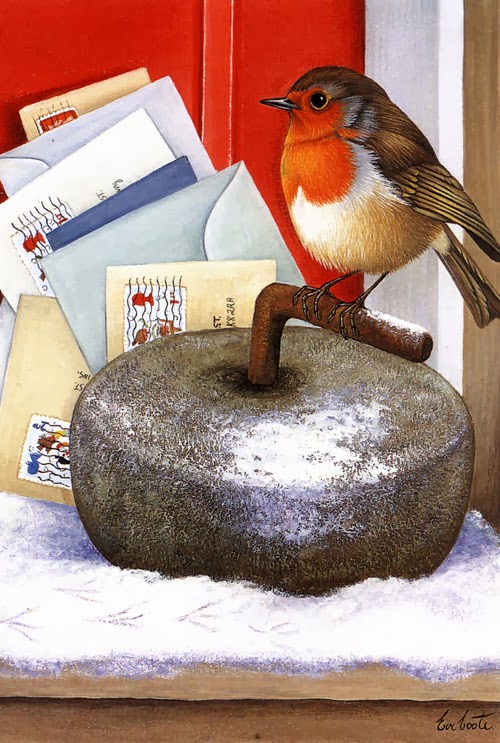
This is another card marketed by the Royal Caledonian Curling Club in association with Cameo Fine Arts of Peebles. The image is entitled 'Christmas Post' by Eve Coote.

Ian Rodney, who devised a cartoon every month for the Scottish Curler magazine in the years 2002-09, drew Santa for this Alternative Curling Club card.

The image on this card is 'Curling Fun' by Canadian artist Terry Ananny.

This card, which was sold in aid of the National Trust for Scotland, uses part of 'The Curling Match' by Charles Altamont Doyle, and is credited to City of Edinburgh Museums and Art Galleries, Scotland/ Bridgeman Art Library, London.

David and I wish all followers of the Curling History blog, and indeed all curlers everywhere, 'Merry Christmas and a Happy New Year'!

Monday, December 09, 2013

'A termination the most melancholy put to the bonspiel'

by Bob Cowan

I came across this cartoon recently. These days it would be seen by many to be in bad taste. It was published in Punch in 1958, and drawn by J W Taylor. Taylor was not one of the more famous Punch cartoonists, but he has at least one big fan, see here. His university education was in Manchester, and he became a school teacher in Stoke. One has to conclude it is unlikely that he had ever personally experienced the joys of curling outside on a deep water loch. I wonder what prompted him to draw this cartoon. However, there is just a nod to the dangers - one of the figures in the background is rushing to the rescue with a ladder!

Of course, if we go back to the eighteenth century and early nineteenth century, long before indoor rinks, and before the first artificial outdoor rinks had been invented, curling was only ever played on natural stretches of water. I quote from David B Smith's 1981 book Curling: an illustrated history, "The advantage of such lochs was their size, their responsiveness to the roar of the stone, their picturesque beauty." David goes on to mention that the disadvantage of deep water is the time it takes to freeze, and that there was a real risk of drowning, should the ice break.  

One of the first questions ever posed to David and I when we began this blog back in the summer of 2008 was, "How common was drowning in the years gone by?" David responded to the question with this post.  Therein he recounted that he had found only one report of death by drowning at a curling match. The reference is in Sir Richard Broun's Memorabilia Curliana Mabenensia, which was written in 1830. The author describes how successful the curlers of Lochmaben had been in matches with neighbouring parishes. Broun writes, "It is sufficient to say, that they have been successful over Tinwald, Torthorwald, Dumfries, Mouswald, Cummertrees, Annan, Dryfesdale, Hutton, Wamphray, Applegarth, Johnstone - and perhaps Kirkmichael might have been added to the list, but for the occurrence of a most disastrous accident by which six individuals were drowned, and a termination the most melancholy put to the bonspiel." He then goes on to give details of the battles between Lochmaben and Closeburn, with no further mention of what appears to be a 'curling disaster'.

In searching the British Newspaper Archive for instances where curlers had come to grief on outside ice, I had found no mention of any accident at Lochmaben when curlers had been drowned. I found a number of stories of curlers falling through the ice, all over the country, but without loss of life. But what struck me - forcibly - was just how many tragic stories there were during the nineteenth century about people who had been skating or sliding on the ice, and died! Local newspapers throughout Britain regularly contained reports of fatal ice accidents during the winter months.

I had come to the conclusion that the reason there was so little information in Broun's book was that the accident had all occurred way back in time, and that the occasion had been passed on simply by word of mouth. But then I got the opportunity to study the original reference, in Memorabilia Curliana Mabenensia. It occurs in Chapter VI of the book, which is entitled 'Bonspielana'. In the paragraph before that about Lochmaben's bonspiel successes, there is reference to famous Lochmaben curlers who had been at the top of their form during the time of the 'French War'. This was a reference to the Napoleonic Wars, which finished with the Battle of Waterloo in 1815. Broun's reference to the Lochmaben tragedy likely dated to the early nineteenth century, a time well covered by papers in the British Newspaper Archive. It then struck me that Broun does not say explicitly that it was curlers who had drowned, only that there had been 'a most disastrous accident'. I searched more generally in the BNA for ice accidents at Lochmaben. No success. Had there been any ice accident in Kirkmichael parish? Eureka! There had ... and it was the one referred to in Broun's book. The story was all well recorded in The Scots Magazine of February 1, 1813, and the Caledonian Mercury of February 4, 1813.

So, we need to go back two hundred years. At that time, travelling any distance was not easy, and curlers from one parish were somewhat restricted to playing against those of neighbouring parishes. Lochmaben's first curling club, the Lochmaben Curling Society, was not constituted until 1823, as Lynne Longmore has recorded in detail in Minutes of Note, see here. Ten years before that date, the curlers of Kirkmichael parish had received a challenge from those of Lochmaben parish and they had met on one of the Lochmaben lochs on Friday, January 29, 1813. The home side was successful and the two groups of curlers agreed to meet again the following day, Saturday, January 30, on Cumrue Loch in Kirkmichael parish. There was 'a vast concourse of spectators' when the match got underway in the morning. By two o'clock 'the ice had become so soft and wet, that it was agreed to change the board, and a few of the young men then attending, went in search of another; they immediately pitched upon one, and while the curlers were carrying their stones towards this new rink, they perceived the ice to give way, and in one moment saw the whole group of young men and boys sink.' Ten persons went in the water, which was around twelve foot deep. Five were rescued, one of the rescuers taking off his coat and holding its edge to use it as a rope, linking hands with others on the ice behind him.

The bodies of the others were recovered later using two ladders tied together to bridge the hole in the ice. All five who died were under 23 years of age. They were William McGill (Corshill), James Paterson (Auchenclurehill), James Dalzell (Parkgate), Robert Muirman (who was a servant in Dalfibble, married with two children) and Peter Carruthers (also a servant in Dalfibble). Singled out for praise for their part in the rescue of the others were James McGill (Corshill) and James Roddan (Pleasance). Presumably William and James McGill were related.

I wondered if all those who died had been locals. Dalfibble is a farm to the west of Cumrue Loch. Parkgate may refer to the farm or the community, again west of Cumrue. I have found old references to 'Pleasance, Kirkmichael', but don't know exactly where this was. And where were Corshill, and Auchenclurehill? I cannot yet find these names on old maps of the area, although Corsua farm is close by.

The story recounted in the newspapers differs in one respect from that in Memorabilia Curliana Mabenensia. The news reports say that there were only five fatalities, whereas Broun indicates that six died. However, it would seem from the newspaper accounts that those who died had not been engaged in the curling match, but were spectators who had tried to help the curlers by seeking out a new place on the loch where a new rink could be laid out. The reports do not mention if the curlers were involved in the rescue attempts, but it is quite apparent why play was abandoned, and why Broun wrote, " ... and a termination the most melancholy put to the bonspiel."

The Lancaster Gazette also ran the story on February 6, 1813, omitting the detail of the curling bonspiel, and putting the blame on two skaters. The report reads, "On Saturday last, as two persons were amusing themselves skaiting on Camrew Loch, in the parish of Kirkmichael, one of them made a dextrous wheel round a number of spectators, who happened to be collected at one place, when the impression of his skaits so weakened the thawing ice, that it instantly gave way, and ten persons were plunged into the water where it was about eleven feet deep." This report also indicates that five were saved, and the rest perished.

Cumrue Loch can be found on modern maps just west of Templand. The grid reference is NY 061860. Lochmaben and Kirkmichael are adjacent parishes. Cumrue Loch is just inside the south east boundary of Kirkmichael parish. It is not (yet) recorded as a 'Curling Place' on the Historical Curling Places database and website. Perhaps because it had been the scene of such a tragedy, the curlers chose not to return there after 1813.

This is Cumrue Loch as it appeared today, a grey December morning in 2013. It sits in the middle of a large dairy farm. My thanks to Brendan, the farmer, for his help in getting me to a spot from where I could take this photo.